
Travel size perfume bottles have quietly become the most commercially interesting format in fragrance packaging — no longer a free sample throwaway, but a repeat-purchase SKU that carries discovery sets, travel retail programmes and subscription refills. If you are sourcing them in 2026, the short answer is this: most brands launch travel size perfume bottles in 5 ml, 10 ml, 15 ml or 30 ml glass, choose between a fine-mist spray, a roll-on or a refillable atomizer, and place a first order of roughly 2,000–3,000 pieces on a stock mold. Anything at or below 100 ml (3.4 oz) also clears the airport liquids rule that governs what consumers can actually carry on a plane.
Core answer for buyers: Travel size perfume bottles are small-format glass flacons — typically 5 ml to 30 ml — fitted with a spray, roll-on or refill atomizer. The 5–10 ml band alone accounts for 39% of the mini refillable perfume bottle market, glass holds the majority material share, and stock-mold minimums usually start at 2,000–3,000 pieces per model. Anything up to 100 ml per container stays compliant with the TSA 3-1-1 carry-on rule.
Why Travel Size Perfume Bottles Became a Core SKU, Not a Freebie
Three forces pushed small formats to the centre of fragrance strategy. First, mobility: airport security rules give consumers a hard reason to own a compliant bottle. Second, discovery: low-risk trial is now how brands recruit buyers, and a 10 ml spray is a retail product in its own right. Third, refill economics — the mini refillable bottle segment exists precisely because consumers want to decant from a large flacon into a portable one.
The numbers behind that shift are unusually well documented. Future Market Insights values the mini refillable perfume bottles market at USD 3,803.0 million in 2025, rising to USD 6,373.9 million by 2035 at a 5.3% CAGR — and it puts glass at 53.4% of segment revenue, the single largest material share. Market.us tracks the same category from USD 3.4 billion in 2023 to USD 5.8 billion by 2033 at a 5.4% CAGR, and its segmentation is the most useful part for packaging buyers: the 5–10 ml capacity band holds 39% of the market, while pumps account for 40% of dispensing mechanisms, ahead of rollerballs and sprays.
Travel-format market at a glance
- USD 3,803.0 M (2025) → USD 6,373.9 M (2035) — mini refillable perfume bottle market, 5.3% CAGR (Future Market Insights)
- 53.4% — glass share of that segment, the leading material (Future Market Insights)
- 39% — share held by the 5–10 ml capacity band (Market.us)
- 40% — share held by pump mechanisms (Market.us)
- 100 ml / 3.4 oz — maximum container size for carry-on liquids (TSA 3-1-1 rule)
For a brand owner the takeaway is blunt: the demand already exists, and the competitive question is not whether to offer a travel format but how well your bottle specification matches what retailers and consumers expect from it.
Travel Size Perfume Bottles: Sizes, Capacity and Neck Finishes
Capacity choice in travel size perfume bottles drives everything downstream — pump length, carton size, filling-line setup and even shipping density. The ranges below reflect what mini perfume bottles wholesale programmes actually run on stock molds.
| Capacity | Typical use case | Dispensing options |
|---|---|---|
| 2–3 ml | Vials, carded samples, perfume oil minis | Screw cap, glass rod, roll-on |
| 5 ml | Deluxe samples, oil-based attars, add-on gifts | Roll-on, screw spray, refill atomizer |
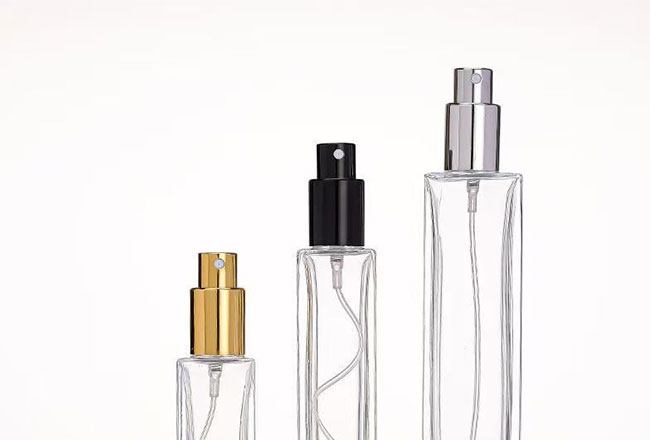
| 10 ml | The travel standard — discovery sets and purse sprays | Fine-mist spray, roll-on, bottom-fill atomizer |
| 15 ml | Extended trips, twin-scent gift sets | Spray with crimped or screw pump |
| 30 ml | Travel retail core size, refill-in bottle | Crimp pump, spray, screw neck |
Two specification details trip up first-time buyers. The first is neck finish: travel sprayers and atomizers most commonly sit on 13/415 to 20/415 FEA necks, and the neck must match the pump you intend to use — a mismatch is a production-stopping error, not a cosmetic one. The second is fill level: a 10 ml bottle holds far less than 10 ml of juice once headspace and pump dip-tube clearance are accounted for, so always specify nominal versus usable capacity when you request a quote.

The TSA 3.4 oz (100 ml) Rule: What It Means for Your Bottle Spec
The regulatory constraint behind the whole travel-size category is simple, and it is worth quoting precisely. According to the Transportation Security Administration:
“Each passenger may carry liquids, gels and aerosols in travel-size containers that are 3.4 ounces or 100 milliliters. Each passenger is limited to one quart-size bag of liquids, gels and aerosols.”
Practically, that yields three sourcing rules. Keep every consumer-facing container at or under 100 ml if you want it in a carry-on — which is why most travel size perfume bottles cluster between 5 ml and 30 ml, leaving plenty of headroom. Avoid marketing a 110 ml or 120 ml flacon as “travel size”, because it will be confiscated at the checkpoint and you will own the negative review. And design your retail carton so a full set of minis still packs into a one-quart bag, because that is how consumers actually travel with them.
Outside the United States the same 100 ml logic applies in most jurisdictions, so a 100 ml ceiling is a safe global specification for any format you intend to sell as travel-ready. If your core business is 50 ml or 100 ml full-size flacons, adding travel size perfume bottles to the range is the lowest-friction way into the travel channel — see our travel perfume bottles programme for the formats that pair with a large flacon.
Spray, Roll-On or Refillable Atomizer: Choosing the Dispenser
The dispenser you fit to travel size perfume bottles changes the shopping experience more than the glass itself. Market.us data showing pumps at 40% of the mini refillable segment is a signal that convenience and low product waste win — but spray, roll-on and refill atomizers each serve a different job.
| Dispenser | Best for | Watch-outs |
|---|---|---|
| Fine-mist spray | Alcohol-based juice, full 360° coverage, retail sale | Pump quality drives perceived value; test spray pattern and actuation force |
| Roll-on / rollerball | Perfume oils, attars, pulse-point application, leak resistance | Ball fit and housing must be validated; oil viscosity affects flow rate |
| Refillable atomizer | Travel retail, refill programmes, premium gift sets | Refill mechanism (spiral, rotary or bottom-fill) must be leak-tested |
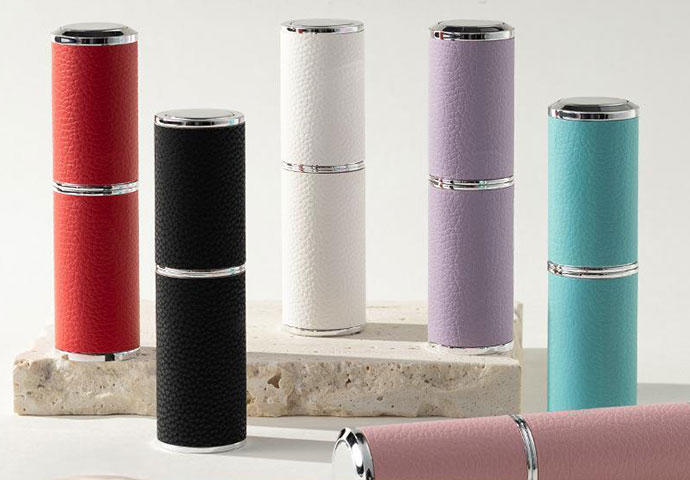
Refill systems deserve their own note, because they are what separates a commodity mini from a branded accessory. The three common routes are a spiral spray bottle that you unscrew and top up, a rotary aluminium sprayer with a glass inner container, and a bottom-fill atomizer that fills without removing the cap. Aluminium shells over a glass liner and bamboo outer cases are also established options when a brand wants a material story that is not plastic — all are available through our glass bottle customization service.
What Is the MOQ for Travel Size Perfume Bottles?
Small formats are the most MOQ-friendly category in glass packaging, because mini bottles pack densely onto a molding line and often run on stock molds. Our own export programmes currently start travel size perfume bottles at 3,000 pieces per model, and the wider picture for mini and travel formats looks like this:
| Route | Typical MOQ | What it means for a travel launch |
|---|---|---|
| Stock mold, standard flint or amber | 2,000–5,000 pcs | Lowest-risk entry; brand via decoration and closure |
| Dropper / spray formats | 3,000–5,000 pcs | Standard for atomizer and roll-on programmes |
| Modified stock (new neck, shoulder or embossing) | from ~10,000 pcs | Differentiation without a full private tool |
| Private mold, exclusive shape | 30,000+ pcs per run | Only justified once sell-through is proven |
Two levers move the number in your favour. First, ride the colour window: if the furnace is already running the glass colour you want, your minimum can drop sharply because the factory avoids a colour change. Second, ask for the assembly quote, not the bottle quote — pumps, atomizers and custom-printed closures each carry their own component minimum, and the closure is frequently the binding constraint on any travel size perfume bottles programme. Our custom glass bottle MOQ guide breaks the full cost logic down further.
Decorating Small Formats: Frosted, Spray Painting and Hot Stamping
Decoration is where travel size perfume bottles earn their premium. The same finishes applied to 100 ml flacons work on travel size perfume bottles, but two mechanics change: registration tolerance tightens as the surface area shrinks, and per-unit decoration cost rises because each bottle carries less glass.
- Frosted finishes — a sandblasted matte surface that reads as premium and hides fingerprints; widely used on travel sprays. See our frosted glass bottles page.
- Colour spraying — full-surface opaque or gradient colour, the fastest way to create a colour family across 5 ml to 30 ml. Explore color spraying for gradient and matte options.
- Hot stamping — metallic foil logos with fine line definition, ideal for small front panels where a screen print would fill in. See hot stamping.
- Electroplating — a mirror-metal finish that gives a mini bottle an accessory feel; pair it with a plain closure so the metal reads as deliberate rather than busy. See electroplated glass bottles.
Combine finishes into one setup where you can — a single frosted-plus-print run on one mold costs less than splitting a small order across two decoration processes. Brands building a full fragrance range should also consider how the travel format echoes the custom perfume bottles in their main line, since shelf adjacency is what makes a mini read as part of the family rather than as merchandise.
Next Step: Spec Your Travel Format With Real Numbers
Travel size perfume bottles reward planning. Fix your travel size perfume bottles specification in this order: capacity and neck finish first, dispenser second, then decoration and quantity locked against a real production schedule. Do it in that order and a 3,000-piece launch is achievable; do it in reverse and you will redesign the pump after the glass is already on the water.
Send us your target capacity, closure direction, decoration preference and annual volume, and we will come back with current stock-model options, your actual minimum order quantity and indicative lead time.