Custom colored glass bottles are never simply “printed” — color is either created inside the glass itself or bonded onto its surface, and that one decision sets your minimum order quantity, your color tolerance and your timeline. This guide explains how colored glass is actually produced, what Pantone color matching can and cannot deliver on a curved bottle, and how to specify custom colored glass bottles so your factory repeats the same result on every reorder.
Core answer: custom colored glass bottles are colored through one of two families of process — bulk coloring (colorant added to the molten batch, so the glass itself is tinted) or surface coloring (spray coating, frosting or electroplating applied to a clear bottle). Surface coloring suits most cosmetic brands: it accepts any Pantone reference, typically starts at 1,000–3,000 pcs per colorway, and is approved against a signed sample with a Delta E tolerance measured under an agreed light source. Bulk-colored glass usually means 10,000+ pcs, because the furnace must be drained and re-tinted between shades.
Color and the glass packaging market at a glance
- US$2.68 bn → US$4.03 bn — value of the global cosmetic and perfume glass packaging market in 2025 versus the 2034 forecast, a 4.64% CAGR (2026–2034). Customization and personalization is named the key trend for that segment.
- PANTONE 11-4201 Cloud Dancer — Pantone’s Color of the Year 2026, a balanced soft white that translates on glass into opaque white coatings and milky frosted finishes.
- 1,000–3,000 pcs per colorway — typical minimum for spray-coated color on a stock bottle, against 10,000+ pcs for furnace-tinted glass.
- 7–12 days for a decorated approval sample; 25–40 days for bulk production after sign-off.
How Are Custom Colored Glass Bottles Made? Two Families, Four Methods
Glass industry technical references describe coloring in two groups. Surface coloring coats metal or metal oxide films onto the glass, or applies a color glaze by spraying or printing. Batch coloring adds colorants to the raw materials — transition-metal ions such as cobalt, manganese, nickel, iron and copper that produce cobalt blue, manganese violet and nickel green.
For buyers that technical split becomes a commercial one: bulk coloring changes what the glass is, while surface coloring changes what it looks like and is far more flexible on short runs. Here is how the four routes compare when you source custom colored glass bottles for a skincare or fragrance launch, and why color coated glass bottles are the option quoted most often.
| Method | How the color is created | Color flexibility | Typical minimum |
|---|---|---|---|
| Bulk-tinted glass | Colorant added to the molten batch in the furnace | Narrow — flint, amber, green, cobalt and similar furnace standards | 10,000+ pcs per color |
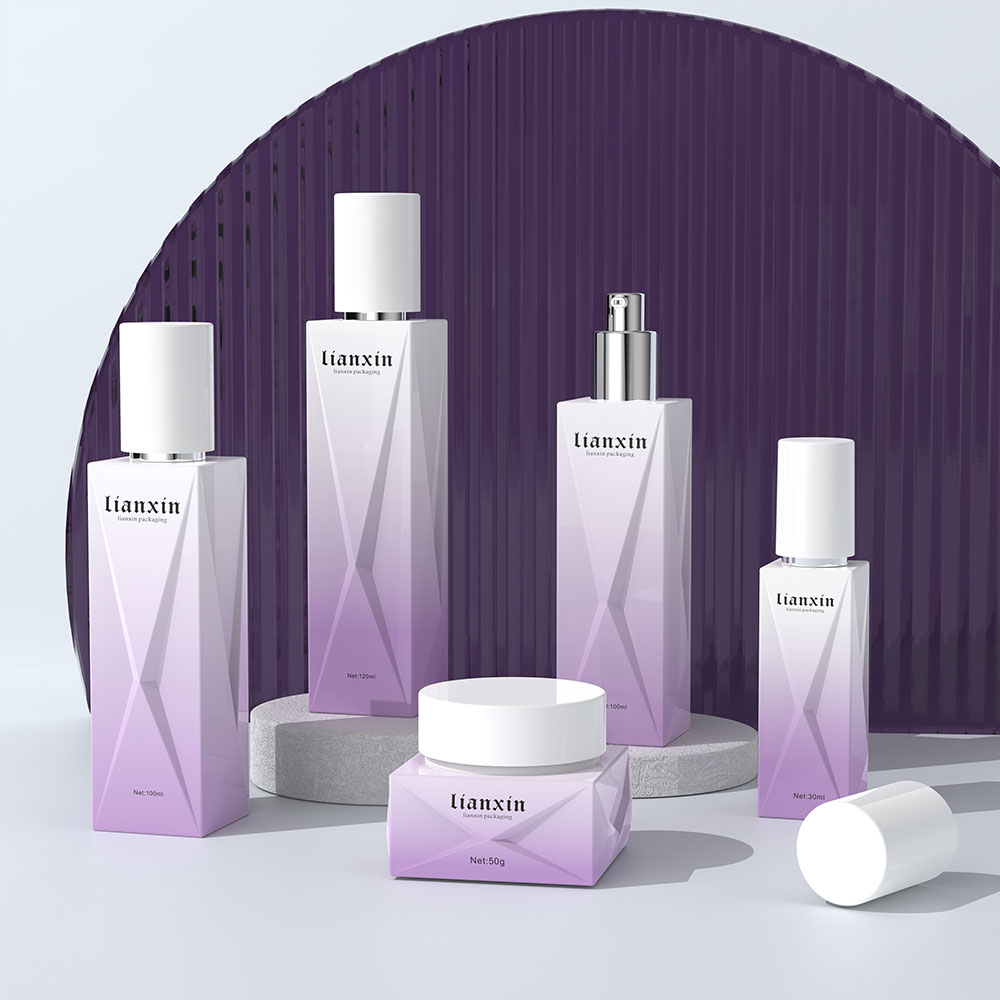
| Spray / color coating | Opaque or translucent lacquer sprayed onto the body, then cured | Unlimited — any Pantone target can be mixed | 1,000–3,000 pcs per colorway |
| Gradient / ombré coating | Two or more coats blended on the line | Two-tone blends; a brand signature look | Higher than a solid coat |
| Frosted plus color | Frosted surface combined with a light tint or white coating | Pastels, milky whites, satin neutrals | Follows the coating minimum |
| Electroplated metallic | Metal layer deposited on the surface for gold, silver or chrome | Metallic families only | Follows the plating batch minimum |
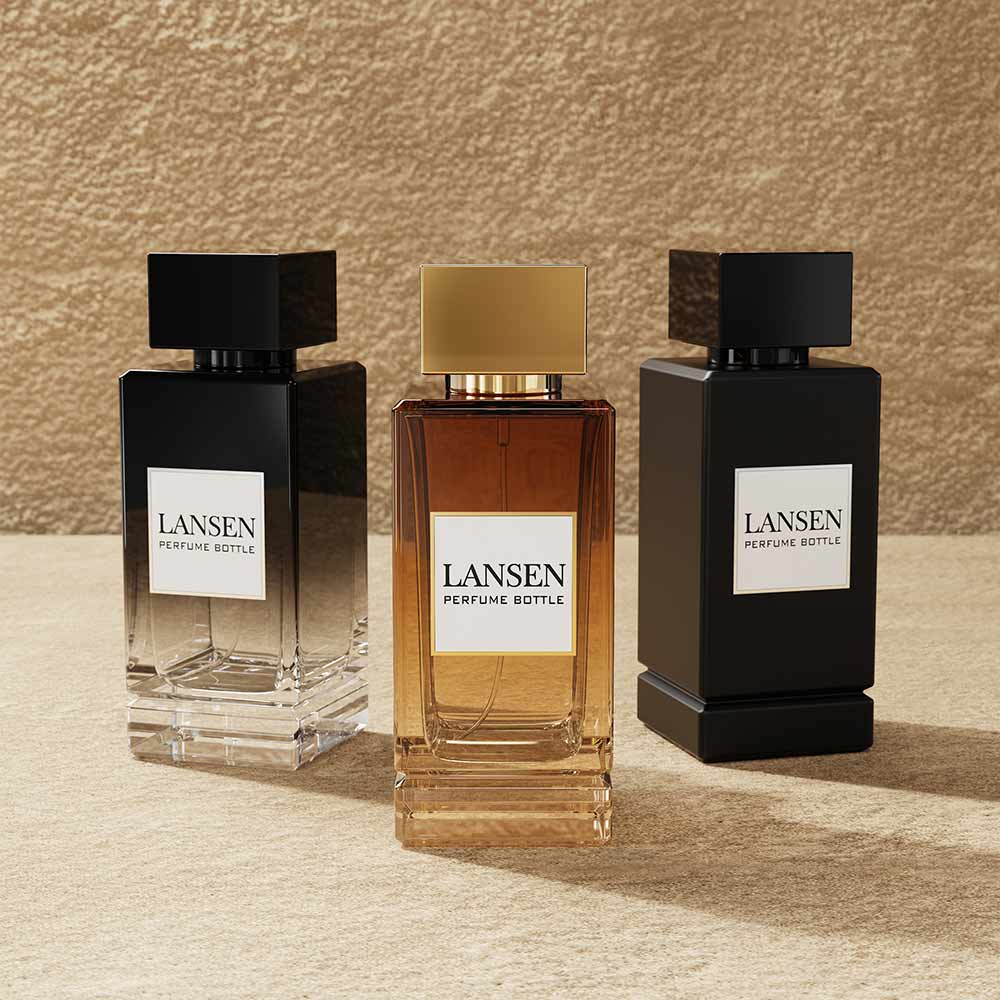
Most brands combine methods: a stock bottle with color spraying for the body, a frosted glass finish where a softer pastel is wanted, and an electroplated metallic finish reserved for the cap or collar so the color story stays coherent without paying for metal across the entire body.
What Does Pantone Color Matching Mean for Custom Colored Glass Bottles?
For custom colored glass bottles, “Pantone matching” is three different jobs, and suppliers quote each one on a different cost base. If you do not say which one you mean, you will approve the wrong sample.
- Print ink matching — a silkscreen logo or graphic visually matches a Pantone reference after curing.
- Coated body color — the whole body is sprayed to approximate a Pantone shade, then cured. Film thickness is critical: if the coating is off by 8–12 μm, the color already reads differently.
- Tinted glass — the glass itself is produced in a colored tone. The most stable look at scale, but the color range narrows and the minimum jumps.
So a realistic specification names the exact code family and the component it applies to — for example PMS 7690 C, body coating, gloss level 3–5 at 60° — rather than “blue glass”. A Pantone chip is printed on coated paper; on clear glass the same pigment shifts with substrate clarity, bottle curvature, print opacity and the light at retail, so an approval on screen proves nothing about the final bottle.
How to read a Delta E tolerance
Delta E measures perceived color difference in LAB space; the CIEDE2000 formula (ΔE00) is the industry standard for color matching and is the preferred metric in ASTM D2244, the standard practice for calculating color tolerances from instrumentally measured coordinates.
- 0–1 — not perceptible; the level used to control print production
- 1–2 — perceptible only on close inspection; a realistic studio target
- 2–10 — perceptible at a glance; commonly accepted on packaging
- 11+ — reads as a different color
The practical consequence: no honest factory promises a perfect single-number guarantee on every unit of custom colored glass bottles. Experienced buyers ask for a visual standard under an agreed light source — a D65 light box rather than the daylight next to the warehouse window — plus a signed golden sample, and use ΔE to prove that sample and bulk run agree.
Custom Colored Glass Bottles: How Do You Keep Color Consistent Across Every Batch?
Color drift is the most common complaint on repeat orders, and it is almost always a process problem rather than a pigment problem. Four controls solve most of it and lock in color consistency on every reorder.
- A signed golden sample. Approve a physical pre-production sample made on the same line as mass production — not a hand-sprayed studio piece, which looks cleaner than jig production and hides the defects you will argue about later.
- A retained formula and retained sample. The factory keeps your pigment recipe, spray parameters and a retained bottle on file, then verifies each new pigment delivery against the original. This is what makes the same shade of custom colored glass bottles repeatable six or twelve months later.
- Defined viewing conditions. Approve color in a D65 light box and state the light source on the purchase order; daylight, retail lighting and phone screens each change perception.
- Documented inspection. AQL 2.5 for major defects with zero tolerance on critical defects, a decoration position tolerance (typically ±1.5 mm), a tape-adhesion or rub check on the coating, and carton drop testing before shipment.
Pack custom colored glass bottles by shade lot so a carton never mixes two coating batches, and put the finish into words on the PO — matte versus glossy, since one missing word can trigger thousands of pieces of rework.
Custom Colored Glass Bottles MOQ: How Color Choice Changes the Minimum
Color is the hidden variable in every minimum order quantity discussion for custom colored glass bottles, because a color change costs the same whether or not a new mold is involved. Industry supplier guides put the practical planning numbers at roughly 1,000 pcs per SKU for a simple one-color decoration on a stock bottle, 2,000–3,000 pcs per colorway once spray coating is involved, and 10,000 pcs or more where the glass itself must be produced in a custom color.
Those numbers for custom colored glass bottles sit on top of the base MOQ for your bottle family. On our own export programs, stock custom perfume bottles start around 2,000–5,000 pieces, while essential oil bottles and nail polish bottles usually ship in the 3,000–5,000 piece bracket, and a private mold program starts at 30,000+ pieces per run. Colored decoration rarely changes the glass minimum — it adds its own setup threshold instead.
Planning minimums for custom colored glass bottles, by color route:
| Color route | Planning MOQ per color | What drives the number |
|---|---|---|
| Clear bottle, no color | Base MOQ only | Mold route and bottle family |
| Spray-coated color | 1,000–3,000 pcs per colorway | Booth setup, gun cleaning, color-change downtime |
| Frosted or gradient color | Higher than a solid coat | Extra passes and masking per unit |
| Furnace-tinted glass | 10,000+ pcs | Furnace color change and off-spec transition glass |
| Custom mold plus custom color | 30,000+ pcs per run | Tooling, exclusive line setup, dedicated furnace time |
Two levers reliably lower the number. First, ride the color window: ask which shade is scheduled next on the line and place your order into it. Second, consolidate SKUs — splitting 6,000 pieces across six Pantone shades costs noticeably more than 6,000 pieces in one shade, because every switch stops the line, cleans the guns and forces packing by shade. For a rare shade on a modest quantity, the efficient answer is usually a clear bottle with a custom color coating rather than tinted glass.
RFQ Checklist: Seven Details That Prevent a Color Dispute
Send these seven lines with your inquiry for custom colored glass bottles and the quotations you receive will be comparable between suppliers — and usable on the production floor.
- Exact Pantone code and family — for example PMS 186 C — plus whether it applies to the print ink, the body coating or the glass itself.
- Finish level — glossy, matte or satin, with the gloss level stated numerically.
- Tolerance target — the ΔE00 value you will accept and the light source used to judge it, with D65 the practical default.
- Reference to the whole assembly — bottle, cap, pump or dropper and box must read as one color story; a cap matched in isolation is the classic mismatch.
- Quantity per colorway, not only the total order quantity.
- Quality terms — AQL 2.5 for major defects, zero tolerance for critical defects, decoration position tolerance and coating adhesion testing.
- Timeline and terms — sample approval in 7–12 days, bulk in 25–40 days after deposit and artwork sign-off, with lead time counted from sample sign-off rather than PO date.
Color also interacts with decoration: a hot-stamped logo over a matte coating behaves differently from the same foil on gloss, so approve the decorated sample, not the undecorated one. A full glass bottle customization program combines color, print and closure for custom colored glass bottles in a single setup round, which is cheaper and easier to keep consistent.
Turning Color Into a Repeatable Specification
Sourcing custom colored glass bottles is not difficult because pigment is difficult — it is difficult because color is decided in three places at once: in the glass batch, in the coating booth and in the light where your customer opens the box. Choose the method that matches your volume, accept a stated tolerance instead of an impossible promise, and lock the result with a signed sample and a retained formula. Brands that follow this sequence launch a colorway once and repeat it for years; brands that approve a PDF spend the next quarter arguing about a batch.
Whether you need 3,000 spray-coated custom colored glass bottles for a serum launch or a 10,000-piece tinted glass run for a flagship fragrance, the fastest route to a real number is a specification review with the factory. Send your Pantone reference, bottle family, capacity and quantity split, and you will get a color-feasibility check, the actual per-colorway minimum and a sample schedule in return.