If you are sourcing recycled glass bottles for cosmetics, here is the core answer up front: glass packaging is commonly made with up to 70% recycled glass, and higher shares are only practical in special batch runs that use extremely high-quality cullet to hold colour consistency. What actually sets your ceiling is not furnace technology — it is how cleanly the recycled glass was sorted by colour before it reached the melt. Clear (flint) bottles carry the tightest limit, while amber and green tolerate colour contamination far better.
Quick answer: Recycled glass bottles for cosmetics typically run at up to 70% post-consumer recycled (PCR) content. Going above 70% is possible, but it requires exceptionally clean, colour-sorted cullet and is normally reserved for special batch runs. Clear glass is the hardest colour to push high; amber and green glass reach the highest recycled shares because a trace of the wrong colour disappears in a dark melt.
Recycled content does not weaken a glass bottle or compromise formula safety, provided the cullet is clean. What it does change is colour consistency, quotation logic and what you can legally claim on pack — all three are covered below.
How Much Recycled Content Can a Glass Bottle Actually Hold?
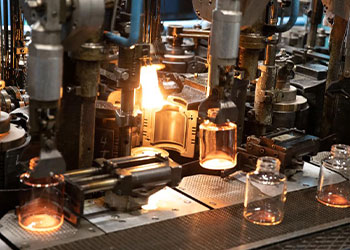
When you request recycled glass bottles, your supplier answers in the language of cullet — and only one of two streams counts toward your recycled-content figure. Internal cullet is the factory’s own material: bottles rejected at inspection, trimmings, and the glass that runs while a machine is being set up. It is clean and its composition is known, but it is not post-consumer recycled content. External cullet comes from collection systems — kerbside schemes, bottle banks and deposit-return programmes — and it is this stream that supports a PCR claim. Processors sort it by colour, remove ceramics, metal and organics, then crush it to a usable size before it is re-melted with the raw batch of sand, soda ash and limestone.
According to the Glass Packaging Institute, glass is typically made with up to 70% recycled glass, and the Institute notes explicitly that PCR amounts above 70% can be used but are limited to special batch runs with extremely high-quality cullet to meet colour consistency goals. That single sentence explains most of the quotation differences you will see from suppliers: the constraint is material quality, not willingness.
Recycled glass in numbers
- Up to 70% recycled glass is typical in container glass production.
- 3.2 million tons of recycled glass are purchased and re-melted annually by the container and fiberglass industries.
- 1 ton of CO₂ is avoided for every 6 tons of recycled container glass used.
- Over 1 ton of natural resources is conserved per ton of glass recycled, including 1,300 lb of sand, 410 lb of soda ash and 380 lb of limestone.
- 2800°F → 2600°F: including cullet in the batch lowers the melting temperature and extends furnace life.
The demand side is moving in the same direction. Grand View Research values the global recycled glass market at $4.5 billion in 2025 and projects growth from $4.8 billion in 2026 to $7.5 billion by 2033, a 6.7% CAGR. In Europe, the supply side is improving as well: Close the Glass Loop reported a record 82.2% collection for recycling rate for glass packaging in 2024, with 87% of collected glass packaging coming from municipal waste management and an estimated 85% of collected glass recycled in a closed loop. The platform’s stated ambition is 90% by 2030.
For a cosmetic brand, recycled content is now a normal specification request rather than an exotic one — but the figure you can hold depends on the colour you choose.
Why Colour, Not Furnace Technology, Sets Your PCR Ceiling
Cullet carries its colour into the melt, so a furnace producing clear glass can only accept clear cullet. British Glass sets out the underlying rule plainly in its guidance on recycled content in glass packaging:
“To achieve clear glass colour contamination must be kept to a very low level; there is greater tolerance on green glass.” — British Glass
This asymmetry explains a pattern you will notice in real quotations: green and amber bottles often carry a higher recycled share than clear bottles from the same factory, and a clear bottle with a very high claimed content usually depends on a well-sorted local cullet stream. A European glassmaker reporting its own performance illustrates the gap — Vetropack’s 2024 integrated annual report records an average recycled content of 57% across all colours, with the highest cullet share reaching 74% for green glass.
| Bottle colour | Tolerance to colour contamination | Realistic PCR ceiling | Design implication |
|---|---|---|---|
| Flint (clear) | Very low — trace colour shifts hue | Lowest of the three | Confirm the actual melt figure before you print a claim |
| Amber | High — mixed stream tolerated | Mid to high | Best fit for light-sensitive formulas and higher PCR |
| Green | Highest — greatest tolerance | Highest of the three | Strong sustainability story with the least colour risk |
If your brand identity depends on a crystal-clear bottle, you have three workable routes rather than one. First, accept a lower but genuinely evidenced PCR figure on flint. Second, specify an opaque or tinted finish — custom colored glass bottles and colour spraying both mask trace colour variation while letting the melt run a higher recycled share. Third, move to frosted glass bottle finishes, where a soft satin surface absorbs the small hue shifts that are visible on polished clear glass.

Does Recycled Glass Cost More? Furnace Economics vs Your Unit Price
Recycled glass bottles are often presented as a cost-saving measure, and at the furnace they genuinely are. The Glass Packaging Institute reports that a 10% increase of cullet in the feed mixture cuts furnace energy needs by nearly 3%, and describes a 2–3% drop in cost for every 10% cullet used in the manufacturing process. The same source notes that a relative 10% increase in cullet reduces particulates by 8%, nitrogen oxide by 4% and sulfur oxides by 10%.
Two cautions matter when you translate that into a purchase order. The first is that furnace economics are not automatically your unit price. Colour-sorted, cosmetic-grade external cullet has to be collected, sorted, de-contaminated and transported, and those steps carry their own cost. A supplier running a high recycled share on a dark colour may still price at or below virgin-glass levels; the same supplier may quote differently on flint, where the usable cullet fraction is smaller.
The second caution is the defect risk hiding in contaminated cullet. Ceramic fragments do not melt at furnace temperature and end up as stones in the bottle wall — a critical defect that fails an AQL inspection rather than a cosmetic quibble. Metal causes similar trouble. This is why recycled-content sourcing is inseparable from quality control, and why the practical procurement sequence is to prototype first, then scale: order a pilot run of custom glass bottle samples in your target colour and PCR level, inspect the finish and the product contact surface, and only then commit to a production batch.
On MOQ and lead time, the driver is the mould, not the recycled content. Stock moulds keep minimums and timelines short because nothing has to be cut; a new private mould adds tooling lead time and a higher first-order minimum regardless of whether the glass runs 20% or 60% PCR. If you are early in the process, the supplier checklist in our guide to how to choose a glass bottle manufacturer covers the commercial questions to settle before tooling.
What to Ask a Recycled Glass Bottle Supplier Before You Order
When you buy recycled glass bottles, the recycled-content figure is only as good as the evidence behind it. Because a furnace runs continuously and melts many batches, no single bottle carries its own recycled-content number. What a supplier can evidence is the average cullet share of the melts that your order ran on. Ask for that, and ask in that form — a claim you cannot document is a liability rather than an asset. Use this checklist on your next RFQ:
- Melt-average cullet share for the melts your order actually ran on — not a company-wide figure.
- Internal or external cullet included in that number, because the two mean very different things to a retailer or a regulator.
- Colour-sorted stream provenance and the contamination controls your supplier applies to ceramics and metal.
- Inspection standard used to catch stones and inclusions, plus the AQL level applied to critical defects.
- Decoration compatibility with your chosen glass colour — frosting, colour spraying and metallised finishes all interact differently with trace colour variation, and our glass bottle customisation services cover the options.
- Pilot sample approval against a signed standard before the production run, with your colour reference recorded.
For fragrance, skincare and aromatherapy programmes, the same questions apply whether you are specifying custom perfume bottles with heavy bases or essential oil bottles in amber glass.
Can You Legally Claim Recycled Content on Your Packaging?
Yes — provided the claim is specific and documented. In the United States, the FTC Green Guides are designed to help marketers avoid environmental claims that mislead consumers, and the recycled content section sets the basic rule that it is deceptive to misrepresent that a product or package is made of recycled material. That has two practical consequences for a cosmetic brand.
First, specify the material and the percentage. A claim should say that the glass bottle contains a stated share of post-consumer recycled glass — not imply that the closure, the box or the whole pack carries the same figure. Second, keep the claim in the format your supplier can evidence: the average recycled content of the melts your order ran on. That wording survives scrutiny because it is what the factory can actually document.
In Europe, the regulatory direction of travel reinforces the same discipline. Close the Glass Loop notes that design-for-recycling criteria have been prepared by CEN in view of the implementation of the Packaging and Packaging Waste Regulation, and the platform’s own message is that increasing collection volumes must be accompanied by a strong focus on collection quality, so that more glass can be recycled back into new containers. A brand that can tie its packaging claim to a verified cullet stream is aligned with where both regulation and retailer requirements are heading — and it has the documentation ready when a buyer asks.
The short version: recycled glass bottles for cosmetics can carry up to 70% PCR content, higher on dark colours with well-sorted cullet, and the limit is colour sorting rather than the furnace. Cost savings exist at the melting stage, not automatically in your unit price. Evidence beats ambition on the pack claim.
If you are specifying recycled glass bottles for an upcoming launch, send us the bottle format, the colour and the PCR level your buyer has asked for. Our engineers will confirm the cullet share running on the lines that match your colour, and what a higher target would mean for your schedule, your MOQ and your unit price — through our contact page or by quoting custom coloured glass bottles alongside your other decoration requirements.