Glass bottle decoration comes down to six methods that cover almost every custom packaging project: frosting, color spraying, electroplating, hot stamping, raised 3D printing and flocking. Frosting is the default for fragrance and skincare because it reads as premium with no print at all. Color spraying is the lowest-cost route to an opaque or matte body. Electroplating gives the highest shine and the tightest inspection standard. Hot stamping adds gold or silver logos on a coated base. Flocking is reserved for caps and velvet-touch accents. This guide compares all six on appearance, durability, MOQ and cost so you can choose a glass bottle decoration that survives your fill line, your freight and your customer’s shelf.
Quick answer: which finish should you choose?
- Fragrance and serum bottles — frosted finish, optionally combined with one metallic hot-stamped logo.
- Opaque colour at volume — color spraying, which is cheaper than plating and hides fill level on purpose.
- Gift sets and closures — electroplating, because mirror metallic sells the unboxing moment.
- Logo only — hot stamping on frosted or sprayed glass; it needs a coated base to bond.
- Tactile or velvet details — raised 3D printing for graphics, flocking for caps and collars.

Why Glass Bottle Decoration Matters More in 2026
Decoration is no longer a cosmetic add-on. As glass repositions from “the cheaper alternative to plastic” to the premium, recyclable format of choice, the finish is what separates one bottle from the hundred identical moulds beside it. Market research firm Future Market Insights puts the glass cosmetic bottle market at USD 3.3 billion in 2025, growing to USD 4.7 billion by 2035 at a 3.5% CAGR, with China forecast to expand fastest at 7.8% CAGR. The same report notes that suppliers able to offer decoration depth win the luxury accounts.
Glass cosmetic bottle market at a glance
- USD 3.3 billion — market value in 2025
- USD 4.7 billion — forecast value in 2035 (3.5% CAGR)
- 40% — share held by dropper bottles in 2025
- 45% — share of demand from skincare
- 7.8% — China’s forecast CAGR, the fastest-growing country
Source: Future Market Insights, Glass Cosmetic Bottle Market (updated October 2025).
“The glass cosmetic bottle market is expected to favor suppliers able to combine luxury appearance with lighter recyclable formats. Beauty brands are likely to choose partners with decoration depth and stable quality control across high-value skincare lines.”
— Ismail Sutaria, Principal Consultant for Packaging, Future Market Insights
That is the commercial reason to care. The operational reason is that decoration is where most quality disputes happen: a bottle that passes dimensional inspection can still fail on a chipped shoulder coating or a scratched plated body.
1. Frosted Glass Bottles: Matte Luxury Without a Label
A frosted glass bottle is the workhorse of premium fragrance and skincare. The surface is turned semi-opaque and light-diffusing, so the glass catches light the way a soft-focus filter does. There are two production routes: acid etching, where the surface is chemically treated, and sprayed frost coating, which is applied and cured. Sprayed frost is the more common choice for cosmetic runs because coverage can be controlled and the effect can be made even from neck to base.
Frosting also enables “spot frost” — frosting a window or band while leaving the rest clear, which creates contrast and shows the liquid where you want it seen. Pair it with a single metallic accent and the package reads far more expensive than the finish actually costs. The trade-off is transparency: full-body frost hides fill level and colour, which is a benefit for amber-tinted formulas and a drawback for products where clarity is the selling point, such as pure essential oils. If clarity matters, keep the frost on the shoulder only.
2. Color Spraying: The Lowest-Cost Route to an Opaque Bottle
Color spraying coats the glass in a cured paint layer, giving you a solid, controllable colour across the whole body — matte, satin or gloss. It is the most economical glass bottle decoration method for making a stock bottle look proprietary, and the only realistic option when you need an exact brand colour matched across bottles, jars and closures. Because the coating is opaque, you can also use it to unify mismatched glass tints or hide minor colour variation between production lots.
Where spraying fails is at the edges. The neck ring, shoulder transition and base are where the coating is thinnest and where bottles rub against each other in transit. Ask your supplier how they mask the neck bore — coating inside the neck can interfere with the pump or dropper seal — and request a rub test plus a tape-adhesion test on the actual colour, not on a generic sample. For matching shades across a full range, see custom color glass bottles.

3. Electroplating: Mirror Metallic, With the Tightest Tolerances
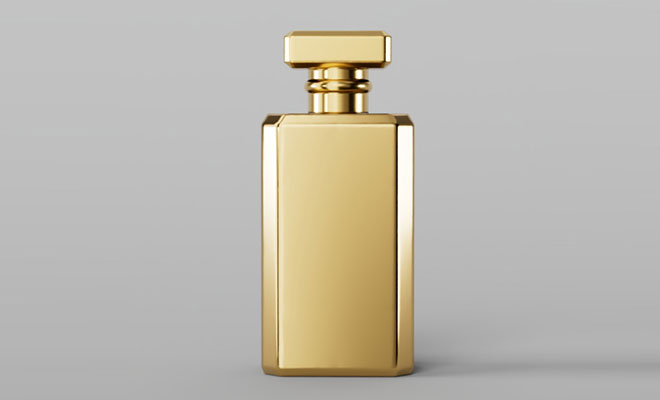
Electroplated glass bottles — technically vacuum metallising, though the industry still says “plating” — produce a mirror surface in gold, silver, rose gold, blue or purple. No other finish photographs as well, which is why plated formats dominate gift sets and holiday launches. The catch is that plating is the least forgiving glass bottle decoration process in the line-up. Any dust, mould seam or scratch on the glass is amplified by the mirror layer rather than hidden by it, so plated bodies demand a higher-grade blank and stricter in-process handling.
Because plating is fully opaque and fragile under abrasion, many buyers restrict it to the closure and use a sprayed or frosted body. That combination keeps the metallic luxury signal at eye level while moving the fragile surface away from the fill line, capping equipment and carton contact. If the body must be plated, specify edge coverage at the shoulder radius and request an adhesion test on the finished lot.
4. Hot Stamping: Gold and Silver Logos That Bond to a Coated Base
Hot stamping transfers metallic foil onto the glass under heat and pressure, producing crisp gold or silver lettering with a brightness that ink cannot match. It is the glass bottle decoration buyers ask for most when the logo has to look metallic. The detail that decides success is the base: foil adheres reliably to sprayed or frosted surfaces and poorly to bare, glossy glass, so hot stamping is normally specified as layer two on top of a coating rather than as a standalone finish. Each foil colour is a separate pass, so one gold logo is efficient and a three-colour metallic crest is not.
For fragrance clients we usually recommend a frosted body plus a single-colour hot-stamped logo: two processes, one shipment. Keep the artwork off the highest-curvature zone of the shoulder, and specify a foil rub test at 500 g pressure so the mark survives handling.
5. 3D Printing and Raised UV: Tactile Brand Marks
Raised printing builds resin layer on layer to create a graphic you can feel — typically 0.2–0.5 mm proud of the surface. It is the fastest glass bottle decoration for adding real texture without tooling, which makes it popular for limited editions and embossed looks without mould cost. 3D printed glass bottle decoration handles fine linework and small type better than screen printing, and it can wrap onto curved shoulders where a label would wrinkle.
Specify it away from high-abrasion zones. A raised mark on the front panel survives months of use; the same mark next to a cap thread will scuff within a carton. If the project needs the texture to be permanent and tooling is justified, an embossed mould is the more durable answer.
6. Flocking: Velvet Touch Where Fingers Land
Flocking applies short fibres to an adhesive layer, producing a suede-like surface. On glass it is almost always a detail glass bottle decoration rather than a full-body one: caps, collars, diffuser shoulders, nail polish handles and the recessed panel behind a logo. Flock adds perceived warmth and grip, and it lets a plastic closure match the tactile language of a glass body without switching materials.
Two production notes matter. First, flock is sensitive to moisture and repeated wiping, so it belongs on components that are touched, not cleaned — not on a body that gets sanitised. Second, fibre colour matching is done per batch, so if flock appears on more than one component, run them in the same lot or accept a visible tonal difference.
Glass Bottle Decoration Methods Compared
| Method | Visual effect | Main durability risk | Best for |
|---|---|---|---|
| Frosting | Soft matte, light-diffusing | Uneven frost on thick shoulders | Fragrance, serum, diffusers |
| Color spraying | Opaque matte, satin or gloss | Chipping at neck and shoulder edges | Skincare, cologne, nail polish |
| Electroplating | Mirror metallic | Scratching, adhesion on sharp radii | Closures, gift sets, premium fragrance |
| Hot stamping | Gold/silver foil logo | Foil rub-off without a coated base | Logo on frosted or sprayed glass |
| 3D printing (raised UV) | Raised tactile graphic | Wear in high-touch zones | Brand marks, limited editions |
| Flocking | Velvet, suede-like touch | Matting or fibre loss when wet | Caps, collars, nail polish handles |
What Is the MOQ for Decorated Glass Bottles?
There is no universal number, and any supplier who quotes one before seeing your artwork is guessing. Decoration MOQ exists because a line burns time and material before the first saleable unit exists: colour changes need line cleaning and verification, each foil or screen adds a setup, plated batches need racks and qualified vacuum cycles, and cure profiles must be re-proven per colour. The MOQ spreads those fixed costs across enough units to make the run viable — a framework the coatings industry sets out as the six cost groups of development, setup, production, secondary work, logistics and change risk (bottlecoatings.com).
So the useful question is not “what is your MOQ” but “what does the MOQ apply to”. Ask specifically whether it applies to the total program, to one bottle format, to one colour and finish, to one artwork version or to one release quantity. A supplier with a 10,000-piece program MOQ may accept 3,000 per SKU; the reverse is rarely true.
Separately from decoration, budget for tooling if you need a proprietary shape. Published supplier guidance puts a sampling mould at roughly USD 800–1,500 and a full production mould set at USD 3,500–6,000 — an investment that only amortises across repeat orders, which is exactly why decoration on a stock mould is the faster first launch.
How to Choose the Right Custom Glass Bottle Finish
Work through these five questions before you request samples. They are the same questions that prevent a claim six weeks after delivery, and they apply to every glass bottle decoration method above.
- Does the customer need to see the liquid? If clarity sells the formula, limit frost and avoid plating on the body. For pure oils, see essential oil bottles.
- Where will the bottle be touched and where will it be cleaned? Put delicate finishes at eye level and durable ones where hands and chemicals go.
- How many units and how many colours? One foil colour and one spray colour keeps setup charges low; every extra colour multiplies them.
- What is your launch quantity against the annual volume? Tooling and custom colour development only make sense if the volume repeats.
- What test will you accept? Name the tests in the purchase order — adhesion, rub, abrasion, and for nail polish bottles, solvent resistance on the coated body.
Get the sequence right and decoration becomes a competitive advantage: frost for perceived value, colour spray for brand consistency, plating for the unboxing moment, foil for the logo. Our custom glass bottle service exists precisely to pressure-test this combination before the mould is cut.
Ready to Spec Your Bottle Finish?
Send us your bottle shape, target colour and annual volume. We will come back with a finish recommendation, MOQ and a sample plan within two business days.