
Quick answer: Glass bottle defects are split into two groups before you ever argue about numbers. Critical defects — cracks, chips on the sealing surface, inner glass, spikes and thin-skinned bubbles at the mouth — carry zero tolerance and are rejected regardless of AQL. Cosmetic defects — bubbles away from the seal, mold seams, wrinkles, slight colour variation — are judged against limits you write into the purchase order.
What decides a shipment: a written defect classification plus a sampling plan, not a visual impression on the factory floor.
Glass bottle defects are the fastest way to lose money in a packaging programme. A single cracked finish can stop a filling line, a stone in the base can shatter under pressure, and a chip on the sealing surface only shows up as a leak three days after capping. In cosmetic and fragrance packaging the stakes are higher than in beverage packaging: bottles are decorated, filled with alcohol-based formulas, and shipped as premium retail units, so a defect that would be “acceptable” in an industrial container becomes a customer complaint.

What Are the Most Dangerous Glass Bottle Defects?
The most dangerous defects are the ones that compromise safety or seal integrity, and industry defect lists classify them as “serious” precisely because the consumer cannot use the bottle normally, and those are the glass bottle defects that end up in a claim. According to a defect taxonomy published by CGP Glass, serious defects include broken mouths, broken glass inside the bottle, severe deformation and insufficient mouth dimensions — anything that endangers personal safety.
Four of them deserve a permanent line in your inspection standard:
- Inner-wall cracks. Defined as cracks of any length and width on the inner surface, wide enough for a fingernail to enter. They are serious because products that are hot-filled, sterilised or filled with pressurised formulas can shatter in the consumer’s hand.
- Glass wire (“telephone call”) and inner glass. A thread of glass or a block of glass stuck to the inside wall, usually produced during hot-end forming. Invisible to a quick glance, unacceptable in any cosmetic bottle.
- Spikes and punch sticking. Sharp glass protrusions on the inner surface, most often near the base or on the inner wall of the neck. They can scratch a dropper pipette or shed glass into the formula.
- Thin-skinned (broken) bubbles. Bubbles on the inner or outer surface, or on the sealing surface, that are too soft — they can be penetrated with a fingernail and will burst during normal use.
Cracks deserve separate treatment because they are the one defect that no sampling plan can excuse. As Kingstar Glass’s importer guide puts it, a crack — whether visible or only detected under polarized light — indicates a structural failure that will propagate under thermal or mechanical stress, and a cracked product should be rejected outright regardless of AQL level.
The three-second test that catches most critical glass bottle defects
- Rotate the bottle under strong transmitted light — look for cords, stones and inner glass.
- Run a fingernail around the sealing surface — a chip or burr catches instantly.
- Check the finish under a polariscope — residual stress shows up as a coloured fringe long before a crack opens.
Glass Bottle Defects by Zone: Finish, Neck, Body and Base
Defect naming only becomes useful when it is tied to a location, because the same flaw has a different severity depending on where it sits. Bottle finish defects are the clearest example. A 0.5 mm seam on the body of a custom perfume bottle may pass; the same seam across the sealing surface will leak. This is why professional glass bottle defects lists are organised by bottle zone rather than by alphabetical order.
| Bottle zone | Typical glass bottle defects | Detection method |
|---|---|---|
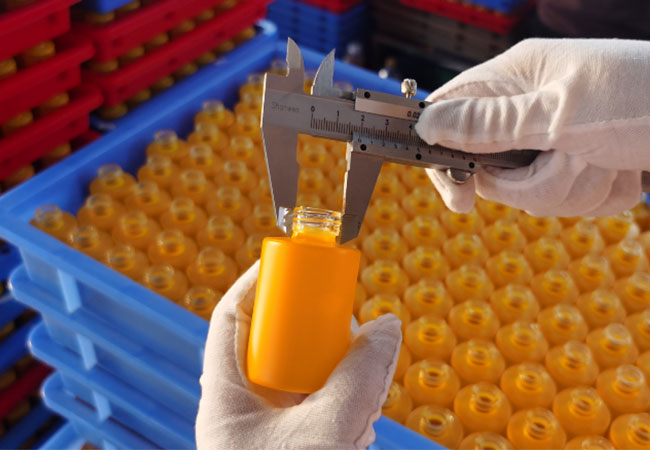
| Finish / mouth | Chipped or broken mouth, burrs on the inner edge, shallow and deep checks, oval or tilted mouth, insufficient thread, rough sealing surface | Fingernail test, go/no-go gauge, vernier caliper, light refraction for shallow checks |
| Neck | Neck cracks, clamp marks, neck folds, wry neck, collapsed shoulder | Visual against limit sample, height gauge, vertical-axis check |
| Body | Cords, stones, wrinkles, cold mold marks, dents, out-of-round, mold seam | Transmitted light, tactile check, diameter gauge, polariscope |
| Base | Radial cracks, spikes, concave or convex bottom, thin bottom, sloping bottom | Visual, thickness gauge, standing stability on a flat plate |
| Dimensions | Height over or under spec, neck bore too small, capacity deviation, wall thickness variation | Caliper, plug gauge, brimful capacity measurement, ultrasonic thickness gauge |

How to Inspect Glass Bottles Before Shipment: 4 Test Categories
A practical glass bottle quality inspection covers four different questions, and confusing them is the most common reason buyers pay for testing that proves the wrong thing. Build the glass bottle inspection checklist around those four questions, then add product-specific items. Appearance inspection asks “does it look right”, dimensional inspection asks “does it fit”, functional testing asks “does it work”, and laboratory safety testing asks “is it safe for its intended use”.
For a cosmetic bottle, the dimensional question is not academic. Small dimensional errors break automation downstream: a container that is 2 mm too tall may not fit the customer’s label applicator, and a lid that is 0.5 mm out of round may leak. Both figures come from the same importer testing guide, and both are defects you will never see in a photograph.
Functional testing is where narrow-neck cosmetic bottles separate good suppliers from cheap ones. A glass bottle destined for an alcohol-based fragrance or a serum should be leak-tested on the filled assembly — vacuum decay or pressure test — with the actual closure and gasket, not a substitute cap. If the bottle is sold in the EU or US as primary packaging, add migration testing for the internal surface and, where decoration touches the product or the lip, lead and cadmium release testing on the decorated area.
What Acceptance Limits Belong in a Glass Bottle Defects Standard?
Once defects are classified, the numbers can be attached — and this is where most purchase orders stay vague. A written standard should define three severity classes with an AQL for each, an inspection level, a sampling plan and a batch definition.
Typical AQL limits for glass primary packaging
- Critical defects — AQL 0.025% to 0.065%. For the sample sizes normally used on glass primary packaging this usually means an acceptance number of zero.
- Major defects — AQL 0.40% to 0.65%. Functional or visible faults that a reasonable customer would return, such as a visible bubble cluster or a significant dimensional deviation.
- Minor defects — AQL 1.50% to 2.5%. Cosmetic issues that do not affect function, such as a small bubble away from the sealing area.
Benchmarked against the attribute requirements used for glass primary packaging in the NGVF 2016 generic attributes document, with sampling governed by ISO 2859-1 at inspection level II for normal inspection.
“A common failure is agreeing to AQL 2.5 without specifying which defects fall into which category. The supplier may classify a chip on the rim as minor, while the buyer considers it a critical defect.” — Kingstar Glass, glassware testing standards for importers
That sentence is the whole argument for a written glass bottle defects standard. Two suppliers can both quote “AQL 2.5” and deliver completely different quality, because the classification — not the number — does the work. That is how glass bottle defects standards are supposed to function. Pin photographs of limit samples to the annex: “bubble cluster acceptable up to this size, at this distance from the finish” is enforceable; “minor bubbles acceptable” is not.
Why Decoration Hides Glass Bottle Defects
Decoration changes what “visible” means, and buyers routinely sign off on inspections that were performed after the bottle had already been covered up. A frosted glass bottle finish scatters light across the surface, which softens mold seams and makes small bubbles far harder to see. Colour spraying and electroplating go further: they physically cover the outer wall, and a thin coating can even bridge a shallow scratch.
The practical fix is to inspect in two stages. Approve the bare glass first — that is the only stage where cords, stones and inner-wall cracks are reliably visible — and then inspect the decorated bottle under grazing light for coating thickness, colour uniformity and coverage at the shoulder and base radius. A supplier who only shows you decorated samples is hiding the inspection window, not simplifying it.
The same logic applies to colour consistency. If the bottle is produced in a custom colour, agree a tolerance and a light source for judging it, otherwise every batch will be argued about under a different lamp.
Where Do Glass Bottle Defects Come From — and How Do You Prevent Them?
Most glass bottle defects are process signatures, not accidents. Cracks trace back to an annealing temperature that is too low, which leaves internal stress in the glass instead of releasing it, or to mechanical shock in handling. Uneven wall thickness comes from uneven temperature distribution in the mold, which changes the cooling rate across the blank. Deformation comes from glass temperature that is too high at forming, so the parison keeps flowing after the mold closes.
That gives buyers three levers that cost nothing to ask for:
- Annealing records. Ask for the lehr curve and a polariscope stress check on the production batch, not just the prototype.
- Mold maintenance schedule. Worn molds produce seams, burrs and dimensional drift long before they produce obvious scrap.
- In-process inspection frequency. A line that checks finish dimensions once per shift will ship a whole pallet of leaking bottles after one bad mold change.
For programmes that run across several bottle types — a fragrance line in perfume bottles, a treatment line in essential oil bottles and a travel format — write one master defect standard and one annex per SKU. Then the customization brief and the inspection standard never drift apart. If you want to see how sampling plans and defect classes fit together in practice, our AQL inspection guide for glass bottles covers the sampling mechanics in detail.
Final Word: Judge Glass Bottle Defects With Limits, Not Opinions
The difference between a smooth packaging programme and a claim-laden one is rarely the factory. It is whether the buyer defined, in writing, which glass bottle defects are critical, which are cosmetic, and what sample size decides the batch. Do that once, attach limit-sample photos, and the same standard protects every future order — including the ones where you are not on site.
If you are specifying a new bottle and want the inspection standard built alongside the spec sheet, send us the drawing, the fill volume and the closure you plan to use.