Premium glass keeps growing. The global glass packaging market was valued at USD 78,483.4 million in 2024 and is projected to reach USD 102,311.2 million by 2030, according to Grand View Research. Every layer of value added on top of that glass — frosting, colour spraying, electroplating, hot stamping, flocking — is also an extra layer that can fail. That is why glass bottle decoration durability belongs in your purchase order as a measurable specification, not in a design presentation as a mood board.
Market context
Source: Grand View Research, glass packaging market report (2024–2030).
Short answer: glass bottle decoration durability is proven by six checks — tape adhesion, cross-hatch adhesion (ASTM D3359), solvent rub, abrasion rub, humidity aging and a product-fill soak test — each with a numeric pass limit agreed before bulk production. If a supplier cannot show those six results with photos, the finish is unverified.
What Is Glass Bottle Decoration Durability?
Glass bottle decoration durability is the ability of a secondary finish to remain visually and functionally intact through the whole life of the pack: filling, capping, labelling, cartoning, palletising, ocean or air freight, retail handling, and the first weeks of consumer use. It is measured at three levels, and buyers usually only test one of them.
- Adhesion — does the ink, paint, foil or flock stay bonded to the glass substrate?
- Chemical resistance — does the finish survive alcohol, fragrance oils, surfactants and the product itself?
- Mechanical resistance — does it resist rubbing, scuffing and bottle-to-bottle contact in a carton?
A finish can pass adhesion and still fail in market. Screen printing, for example, is cured at high temperature — inks are fired at up to 1,180°F according to Berginglass’ technical guide to screen printing on glass bottles — which produces excellent bond strength, but does nothing for a coating that is attacked by the ethanol in your fragrance. That is why the test matrix below covers all three levels.
Why Decoration Peels, Fades or Scratches: 5 Root Causes
Most decoration failures are traceable to process control, not to bad ink. When a buyer reports peeling on colour sprayed glass bottle, the decoration durability conversation should start with these five variables.
- Surface condition before coating. Dust, mould release agents, condensation and handling oils all lower surface energy. A coating applied over an unwashed bottle will look perfect on day one and lift at the edges within weeks.
- Cure temperature and dwell time. Under-cured ink stays soft and smears; over-cured ink becomes brittle and chips. Both failures look identical in a photo and completely different in a rub test.
- Coating system mismatch. Glass and cured organic coatings expand at different rates. A rigid, high-gloss system on a thin-wall bottle will crack at the shoulder where the glass flexes.
- Frosting and etching residue. Acid-frosted surfaces must be neutralised and rinsed completely. Residual acid keeps attacking the bond line and shows up as patchy white blooming months later.
- Abrasion in packing. Bottles rubbing against each other in a carton will dull a matte finish and scuff a metallic one, even when the coating itself is sound.
Rule of thumb from the factory floor: if a decoration fails within the first 48 hours of a humidity test, the cause is almost always surface preparation. If it fails only after a solvent or product soak, the cause is almost always the coating system.
The 6 Tests That Prove Glass Bottle Decoration Durability
These are the six checks we run to prove decoration durability on decorated glass before a bulk run ships. The pass limits are the ones we write into the specification sheet, and buyers are welcome to hold us to them.
| Test | Method | What it catches | Pass limit we specify |
|---|---|---|---|
| 1. Tape adhesion | 3M 600 tape, 10 samples conditioned 24 h at 23°C / 50% RH, 1 min dwell, 45° peel | Weak bond, under-cure | No ink transfer to tape; zero lift at edges |
| 2. Cross-hatch | Lattice cut + tape pull, rated on the ASTM D3359 0–5 scale | Brittle or badly bonded coating systems | 4B or 5B on every sample |
| 3. Solvent rub | Cotton cloth saturated with 70% IPA, 50 double rubs on the printed area | Ink that dissolves in alcohol or fragrance | No colour on cloth, no gloss change visible at arm’s length |
| 4. Abrasion rub | Weighted rub with standard cloth across the finish, strokes counted to breakthrough | Soft coatings that scuff in the carton | No substrate visible at the agreed stroke count |
| 5. Humidity aging | 48 h at 40°C / 90% RH, then re-run test 1 | Blisters and edge lift on sea freight | No blistering, no colour shift, tape test still clean |
| 6. Product-fill soak | 7 days at 45°C filled with your actual formula, then inspected | Attack from fragrance oil, acid or surfactant | No softening, no colour migration, no lifting at the fill line |
Test 1 deserves a note on procedure, because the details decide whether the result means anything. A defensible tape test uses ten representative samples, conditions them for 24 hours at 23°C / 50% RH, holds the tape for one minute, then peels at 45° at medium speed — the sequence published in this coating adhesion test protocol. Skip the conditioning step and you are measuring room humidity, not the coating.
Test Criteria by Finish Type
Different decorations fail in different ways, so the decoration durability test you prioritise changes with the finish. A frosted glass bottle rarely peels; it goes shiny where it rubs. An electroplated bottle rarely scuffs; it corrodes from a pinhole.
| Finish | Typical failure mode | Highest-priority test |
|---|---|---|
| Frosting / etching | Scratches read as shiny streaks; polishing to gloss where handled; patchy etch depth | Abrasion rub + visual gloss comparison against the approved sample |
| Colour spraying (matte or gloss) | Edge lift, chipping at the shoulder, shade drift between batches | Cross-hatch + humidity aging |
| Electroplating | Corrosion blooming from pinholes; clouding after alcohol contact | Solvent rub + salt-spray or humidity exposure |
| Hot stamping | Foil flaking at thin strokes; edge lifting on curved surfaces | Tape adhesion on the finest line weight in the artwork |
| Flocking | Fibre shedding; bald patches after handling | Abrasion rub + adhesive residue check |
The practical takeaway: test the finish where it is weakest, not where it is easiest to test. On a hot stamped glass bottle, that means the 1 mm highlight in the logo, not the solid 12 mm block. On a flocked glass bottle, it means the shoulder radius, not the flat base.
How to Write Decoration Durability Into Your Purchase Order
A decoration durability requirement that lives only in an email is not a requirement. Put it in the PO and in the approved-sample record, in five lines:
- Named test and standard — e.g. “Cross-hatch per ASTM D3359, minimum 4B.”
- Sample size and AQL — state the inspection level and the acceptance number, and tie it to the general customisation specification for the order.
- Conditioning — 24 h at 23°C / 50% RH before testing, so results are comparable between factories.
- Reference sample retention — sign and date a golden sample, keep it for at least six months, and photograph it under fixed lighting so a future batch can be compared without argument.
- Colour tolerance — define an agreed Delta E limit for the sprayed colour, measured on the same instrument both sides.
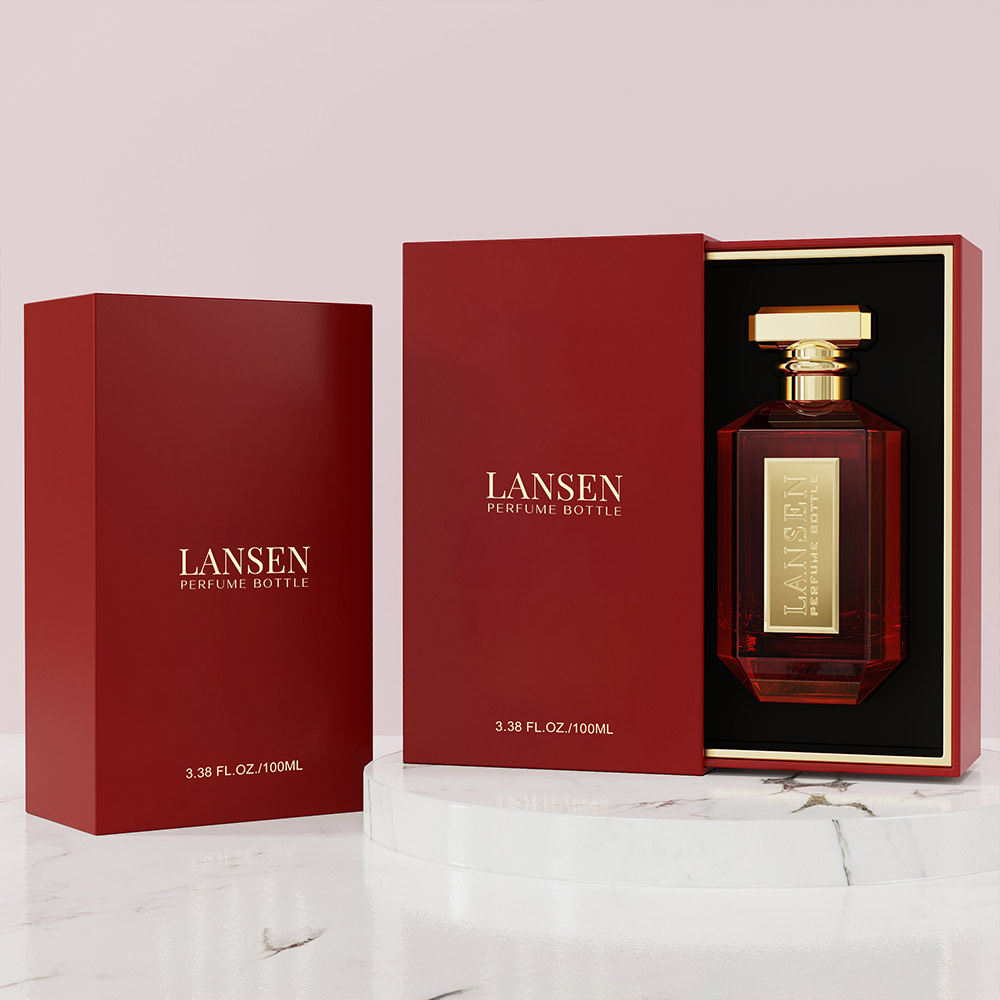
For fragrance and skincare programmes, add one clause that most POs miss: the soak test in test 6 must use your formula, not a generic ethanol-water mix. A perfume bottle holding a high-citrus fragrance behaves very differently from the same bottle holding an alcohol-free oil. The same applies to nail polish bottles, where acetone-based product is far more aggressive than the IPA used in a standard rub test.
Red Flags in a Supplier’s Test Report
Test reports are easy to produce and hard to verify, so read them like an auditor. Six signals should stop a purchase order:
- No conditioning statement. If the report does not say the samples sat at 23°C / 50% RH, the numbers are not comparable to anything.
- No photographs. A pass with no image of the tested area after peeling is an assertion, not evidence.
- Testing only unprinted glass. Adhesion measured on bare glass tells you nothing about the ink you are paying for.
- One sample per test. A single pass on a single bottle is luck; ten samples is a sample.
- No product-fill soak. The most common field failure — coating attacked by the formula — is the test most often missing.
- “SGS passed” with no scope. A certificate covering bottle dimensions does not cover decoration durability. Ask for the test item list.
Conclusion: Specify It, Then Verify It
Decoration is the part of the pack the customer actually touches, and it is the part most likely to be specified in adjectives rather than numbers. Fix that by converting “premium matte finish” into a cross-hatch rating, a rub count and a soak duration. Glass bottle decoration durability then stops being a matter of opinion at goods-in and becomes a line on an inspection report.
If you are sourcing decorated glass for a fragrance, skincare or nail colour launch, we can send a test report on the specific finish you are considering — before you commit to a mould or a bulk run.
Related reading: frosted glass bottles, colour spraying, electroplating, custom glass bottle customisation, and our essential oil bottle range.