Wholesale glass candle jars are the largest packaging line item for most candle brands, and how you order them decides both your landed cost and your safety compliance. The quick answer: buy stock jars while you test a market, move to decorated stock jars once your colour, finish and label are locked, and only pay for a custom mould when volume can absorb the tooling. Ordered well, wholesale glass candle jars can carry close to 30% of your product’s perceived value; ordered badly, they arrive cracked, late or outside your market’s safety rules. In wholesale candle lines, sizes from 3 oz to 16 oz cover almost every SKU, and an 8 oz vessel does most of the volume work.
What buyers ask us most: “What is the MOQ for wholesale glass candle jars?” Stock vessels usually start at 100-1,000 pcs per SKU. A stock jar with your logo or a custom finish normally starts at 1,000 pcs. A brand-new proprietary mould typically starts at 10,000 pcs or more, because tooling has to be amortised across the run.
This guide covers the size ladder and burn times, finish and lid options, real MOQ tiers, and the quality checks to run before you pay a deposit.
Why Wholesale Glass Candle Jars Drive Your Retail Price
Candle demand keeps climbing, and the vessel is where a brand justifies its price. Econ Market Research values the global luxury candle market at US$2.6 billion in 2026 and projects US$4.42 billion by 2035, a 6.30% CAGR. Lucintel puts the wider candle market on a 6.4% CAGR from 2025 to 2031, driven by aromatherapy, home-decor spending and festive gifting. The container side is expanding with it: MarkWide Research sizes the straight-sided glass jar market at $4.8 billion in 2026, reaching $7.91 billion by 2035 at a 5.70% CAGR, with candle and craft applications named among the demand drivers.
That growth explains why glass is the default candle vessel, but it also means your packaging budget is visible on the shelf. Econ Market Research notes that premium packaging contributes nearly 30% of perceived product value, and that luxury packaging – thick glass jars and decorative lids included – can add 15% to 25% to the final product cost. Around a third of consumers name packaging aesthetics as a primary buying factor.
“Premium candle packaging contributes nearly 30% of perceived product value, with luxury glass jars, ceramic containers, and hand-crafted vessels widely adopted by high-end brands.” – Econ Market Research, Luxury Candle Market report
Numbers to plan around
- Luxury candle market: US$2.6B (2026) to US$4.42B (2035), 6.30% CAGR
- Global candle market: 6.4% CAGR, 2025-2031
- Straight-sided glass jar market: $4.8B (2026) to $7.91B (2035), 5.70% CAGR
- Thick glass vessels plus decorative lids add 15-25% to product cost
- About 31% of premium candle brands have launched refillable glass containers
The refillable angle is worth planning for now: Econ Market Research reports that roughly 31% of premium candle brands introduced refillable glass vessels, a concept that cuts packaging waste per cycle while keeping customers buying refills. If your wholesale glass candle jars are designed to be kept rather than thrown away, finish and lid quality matter more than the wax weight printed on the label.
What Glass Candle Jar Sizes Should a Candle Brand Order?
Glass candle jar sizes set your burn time, your wick count, your freight weight and your retail price. Container-candle sizing guidance from packaging distributor F.H. Packaging maps standard jar formats to realistic use cases:
| Jar size | Wax capacity (approx.) | Best for | Estimated burn time |
|---|---|---|---|
| 3-5 oz | 2.5-4.3 oz | Samplers, travel, gift add-ons | 15-30 hrs |
| 6-8 oz | 5-7 oz | Core everyday SKU | 35-55 hrs |
| 10-12 oz | 8.6-10.3 oz | Mid-premium, multi-wick | 50-75 hrs |
| 14-16 oz | 12-13.8 oz | Statement and luxury formats | 70-90+ hrs |
Two numbers keep buyers out of trouble. First, listed capacity is fluid ounces, and wax weight is lower: multiply fluid ounces by roughly 0.86, so an 8.5 oz jar takes about 7.3 oz of wax and a 16 oz jar about 13.8 oz. Second, wick selection follows diameter, not capacity: jars under about 2.5 inches normally take a single wick, while 3-4 inch openings often need two or three to reach a full melt pool and avoid tunnelling.
For a first collection the practical ladder is 4 oz sampler + 8 oz core + 12 oz premium. For wholesale glass candle jars the 8-12 oz band is the most common core range: it holds roughly 7-10 oz of wax, supports a single wick in most configurations, and sits at a price point that works for both everyday purchase and gifting. If you need a non-standard diameter – a wide-mouth format for a three-wick pour, for example – that is a custom glass candle jar project rather than a stock order, and it should be specified before you design the label.
Material choice matters for eco-positioned SKUs. Recycled glass containers, including 50-100% recycled content options, are now widely available from wholesale suppliers, and Econ Market Research reports that adoption of eco-friendly materials such as recycled glass containers and bamboo lids grew across more than 35% of premium brands between 2023 and 2025.
Which Finishes and Lids Fit Your Candle Brand?
Finish is the cheapest way to make one stock shape look like two different brands. Candle glass usually ships in one of four finish families:
- Clear – shows the wax colour and any layers; the safest choice for layered pours.
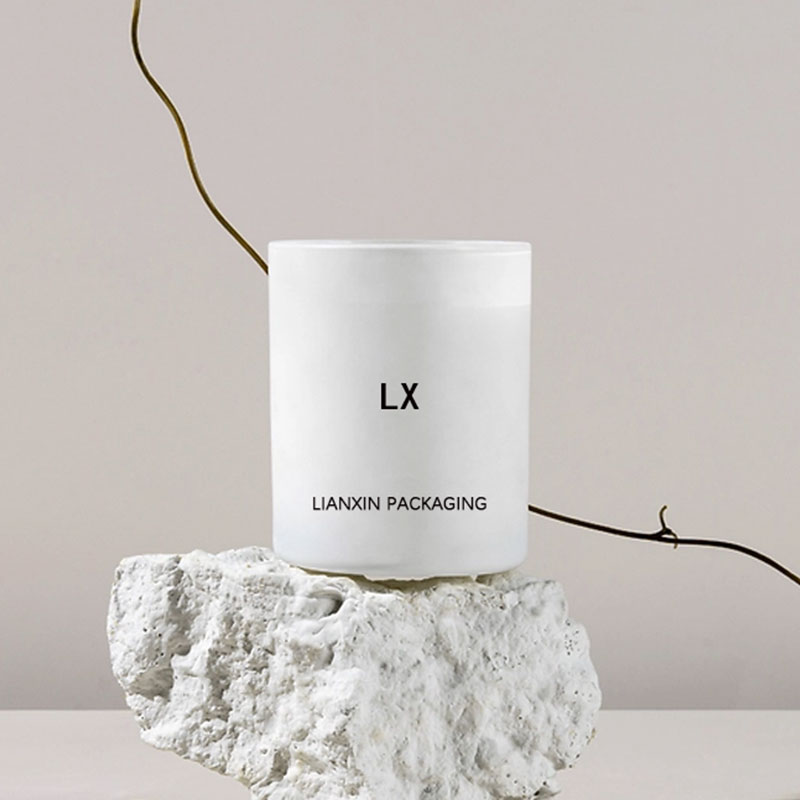
- Frosted glass candle jars – the finish diffuses light and softens the wax colour underneath, which helps when the fill has to look consistent across batches. See our frosted glass finish range.
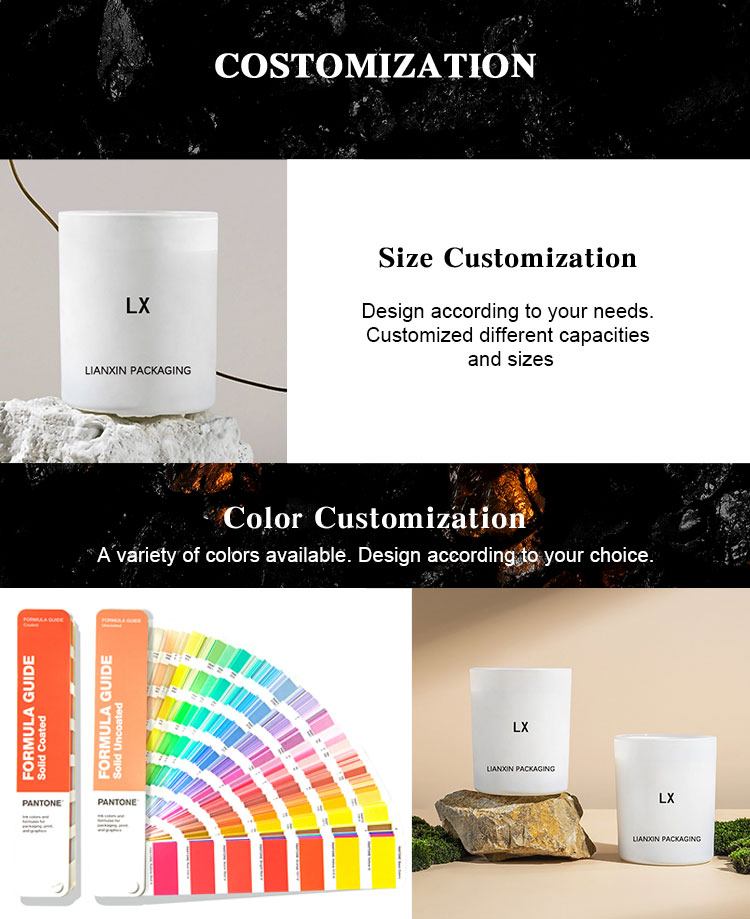
- Painted or matte – the route to matte black candle jars and other opaque colourways: colour hides the wax entirely and lets the vessel carry the scent-family signal. Matte absorbs light and reads understated; glossy reflects and reads sharper. Colour is applied by colour spraying and matched to your custom Pantone colour.
- Metallic – electroplated finishes in gold, silver, rose gold or gunmetal for premium and gifting lines.

Decoration goes beyond colour. Glass factories regularly offer screen printing, decal printing, laser printing, sandblasting, ion plating, colour spraying and electroplating as in-house deep-processing steps – Chinese glassware manufacturer Sunny Glassware lists that process menu for its candle containers. The practical question is whether your supplier runs those processes in-house or subcontracts them, because that decides your lead time and who owns the defect if a print peels.
Candle jar lids are the second decision. Bamboo, wooden, metal, glass, cork and plastic closures are all available, and each changes the perceived price point: bamboo suits eco and artisanal lines, brass-finish or matte metal suits luxury, snap and screw lids suit travel formats. Ask for fit testing across batches, not one perfect sample, because a lid that seals on the first article can bind or rattle once mould wear sets in. A supplier checklist from Candle Jar Wholesale flags exactly this: lid fit, decoration durability and glass strength should be documented, not assumed.
What Is the MOQ for Custom Glass Candle Jars?
The candle jar MOQ you are quoted is not a policy number a factory invents; it is the volume at which setup work stops losing money on wholesale glass candle jars. Three things drive it: decoration setup (screen and decal plates, spray batches), mould tooling for a new shape, and the economics of a furnace run. Across the industry you will see four tiers:
| Order type | Typical MOQ | What you get |
|---|---|---|
| Stock jar, no decoration | 100-1,000 pcs | Off-the-shelf vessel plus standard lid, shortest lead time |
| Stock jar with custom decoration | 1,000-10,000 pcs | Your logo, matte or painted colour, frosted or frosted-tint finish |
| Bulk stock programme | from 10,000 pcs per SKU | Priority production slots and a lower piece price |
| New proprietary mould | from 10,000 pcs, often far higher | Your own shape and size, with tooling amortised across the run |
Those tiers show up in real quotes. One China-based glass jar supplier lists 100 pcs for stock goods and 1,000 pcs for customised products, while another opens logo customisation at 1,000 pcs; factories built around large furnaces go the other way and quote only from 300,000 pcs. That spread is not arbitrary – it tells you which business model you are buying from.
Read the tiers as a sequence, not a menu. Most brands start with stock vessels, test the burn and the market, then move to decoration on the same shape. A new mould only pays off when your monthly volume holds and the shape is genuinely part of the brand – which is where a 3D-printed prototype saves money, because you approve the geometry before anyone cuts steel.
Samples come before all of it. Ask for a pre-production sample round covering dimensional accuracy (height, diameter, base flatness), finish quality (bubbles, cracks, uneven coating), lid fit, decoration approval against your artwork, and a burn test with your actual wax and wick inside the jar. Approve in writing, with photos, so mass production has a reference. If a supplier resists a burn test, that is the answer you need about their quality culture.
Finally, sequence the order against the calendar. Seasonal demand concentrates: roughly 35% of candle purchases happen in the holiday window, so glass and lid supply tightens in the months before it. Brands that book vessels a season ahead spend that season filling candles instead of chasing glass.
How Do You Verify Candle Jar Quality Before Mass Production?
Purpose-built candle glass is annealed to reduce the risk of thermal shock – the process that separates a candle vessel from an ordinary food jar – and annealing quality cannot be judged by eye. Build your approval around documented checks:
- Glass strength: thermal-shock and wall-thickness testing, with recorded tolerances rather than “looks fine”.
- Lid fit: seal and fit verified across batches, not on a single golden sample.
- Decoration durability: print and coating adhesion, plus fade and peel resistance.
- In-process QC: inspection at pouring, decoration and packing stages.
- Pre-shipment inspection (PSI): third-party AQL inspection before the container leaves, plus carton strength and stacking checks for export.
- Documentation: batch records, certificates of conformity for materials and independent lab test reports on request.
Compliance runs alongside quality. For filled candles sold into the United States, ASTM F2417 covers fire-safety requirements; in the EU, EN 15493 covers container stability, temperature performance and safety labelling. Coatings, inks and decorative finishes sit under food-contact and chemical rules such as FDA and REACH, which is one more reason to keep finish suppliers inside the same audited factory. Factory-level certifications such as ISO 9001, BSCI or SMETA tell you whether the management system behind those tests is real or improvised.
Two audit questions separate good candle jar suppliers from good salespeople: do they own their decoration lines or subcontract them, and do they provide batch traceability for the jars you received? Ask for both in writing and keep the answers with your approved sample.
Next step: specify the jar before you print the label
Wholesale glass candle jars reward planning more than negotiation. Lock the size ladder (4 oz, 8 oz, 12 oz), choose the finish family that carries your brand signal, confirm the lid across batches, and buy decoration at the volume where setup cost actually disappears. That is the difference between a jar that looks premium and a jar that costs premium without earning it back at retail.
Our team handles custom glass candle jars end to end: mould development, colour spraying, frosted and electroplated finishes, lid sourcing and pre-shipment inspection, with samples approved before mass production.