

Short answer: a perfume bottle pump is specified by two numbers — collar size (the FEA dimension) and dosage (millilitres per spray). Most retail fragrances use an FEA15 crimp pump on a 30 ml to 50 ml bottle, at 0.08 ml to 0.12 ml per press. Crimp pumps are sealed permanently for shipping and tamper evidence; screw pumps thread on and come off, suiting testers, travel formats and refillable lines but staying rare in commercial fine fragrance.
Get the pump wrong and the failure is not cosmetic: a collar 0.2 mm off spec leaks in transit, an over-heavy dosage makes a 50 ml extrait feel empty after three weeks, and a spring that corrodes in high-alcohol juice leaves metal in the formula. Perfumes accounted for 45.32% of revenue in the cosmetic and perfumery glass bottle packaging market in 2025 — a market valued at USD 2.73 billion in 2026 and forecast to reach USD 3.42 billion by 2031 at a 4.61% CAGR, according to Mordor Intelligence. This guide covers pump mechanics, crimp versus screw closures, FEA sizing, dosage math, compatibility testing, and MOQ and lead time.
What Is a Perfume Bottle Pump and How Does It Work?
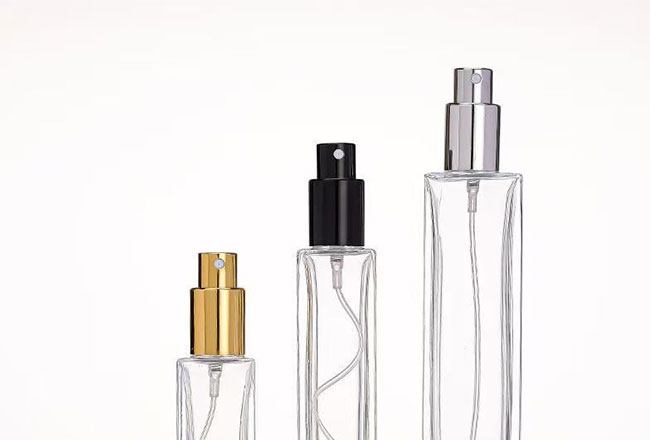
A perfume bottle pump is a mechanical fine-mist sprayer that draws fragrance from the bottle and disperses it as a mist. There is no propellant and no electronics: pressing the actuator compresses a spring that forces liquid through a narrow channel and out of the nozzle, breaking the stream into droplets. Releasing it lets the spring rebound and create a vacuum that pulls the next charge up through the dip tube.
Five components decide whether that spray feels premium or cheap:
- Actuator — the button you press, containing the nozzle orifice that sets the spray cone. Low-profile versions are used when a heavy cap must sit flush.
- Collar (ferrule) — the metal ring that locks the pump onto the neck. On a crimp pump it is deformed inward permanently; on a screw pump it carries threads. Its diameter is what the FEA number refers to.
- Pump body — the housing holding piston, ball valve and spring; its tolerances decide whether output stays consistent press after press.
- Spring — sets actuation force. Too light and the pump sinks under light pressure; too stiff and the spray feels heavy-handed.
- Dip tube — channels liquid from the bottle base into the pump. Length must be matched to your bottle interior height, never guessed.
Fragrance is an alcohol-based product, which changes the material brief. Pumps engineered for water-based lotions may not seal or spray correctly with high-ethanol juice, so confirm the pump is rated for alcohol-based formulations when you pair it with custom perfume bottles.
Crimp Pump vs Screw Pump: Which Closure Should You Specify?
Most fragrance brands get this wrong because both options look almost identical at sample stage. The difference is how the collar attaches to the neck, which drives your filling line, refill story and leak risk.
A crimp pump is sealed by deforming the aluminium collar around the neck ring with a crimping tool. Once crimped, the pump cannot be removed without damaging the collar or the glass. That creates an airtight, tamper-evident seal and a clean silhouette with no visible threads — what consumers expect from fine fragrance. The trade-offs: you need a handheld crimper for small batches or a tabletop unit for volume, and the bottle cannot be refilled or the pump swapped.
A screw pump threads onto the neck and can be removed and reattached, making it practical for testers, sampling, travel formats and refill-positioned lines. Its weakness is mechanical: a threaded connection can loosen in transit and leak, which is why screw pumps stay uncommon in commercial retail fragrance.
| Specification | Crimp pump | Screw pump |
|---|---|---|
| Attachment | Collar deformed around neck ring | Threaded onto bottle neck |
| Removable | No — sealed permanently | Yes |
| Tamper evidence | Inherent | Requires an added feature |
| Appearance | Seamless, no visible threads | Visible thread line |
| Filling equipment | Handheld or tabletop crimper required | No crimper required |
| Leak risk in transit | Low | Higher — threads can loosen |
| Best for | Retail-ready fine fragrance | Testers, sampling, travel, refill lines |
The two neck types are not interchangeable: a crimp-neck bottle carries a flange the collar grips, a screw-neck bottle carries threads. The same logic applies on essential oil bottles, where screw necks dominate because the contents are meant to be reused.
FEA Collar Sizes: Matching a Perfume Pump to Your Bottle Neck
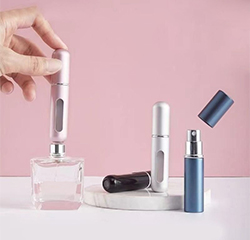
FEA stands for the Fragrance and Essential oil Association, the European body that standardised collar dimensions. The FEA number is the internal diameter of the pump collar in millimetres, and it is the first specification to match before ordering.
| FEA size | Collar diameter | Typical bottle format |
|---|---|---|
| FEA10 | 10 mm | 5 ml to 10 ml travel and sample sizes |
| FEA12 | 12 mm | Some compact 10 ml to 20 ml bottles |
| FEA15 | 15 mm | Most 30 ml and 50 ml stock bottles — the indie fragrance default |
| FEA18 | 18 mm | 75 ml, 100 ml and above; some heavy-wall 50 ml |
| FEA20 | 20 mm | Large formats, body sprays and hair mists above 100 ml |
Published pump guidance is blunt about the risk: FEA sizes are not interchangeable, an FEA15 pump will not fit an FEA18 bottle neck, and buyers should confirm the collar size with the bottle supplier instead of assuming it (Packamor spray pump guide). A 50 ml bottle can be moulded with either neck. Necks are also published as two figures such as 18/415 — diameter plus thread profile — so test the complete bottle-and-pump assembly before mass production rather than trusting nominal specs (UnionSprayer buyer guide). If you are commissioning a shape rather than buying stock, collar size is a specification you set at the custom mould and OEM/ODM stage, not something you retrofit after tooling is paid for.
Perfume Pump Dosage: How Many Sprays Per Bottle?
Dosage is the volume delivered per press, measured in millilitres, and it is the most commonly skipped specification in a fragrance brief. It sets how the spray feels, how fast the bottle appears to empty, and what your product copy can claim.
The arithmetic is worth doing before you write a product page. On a 50 ml bottle, a 0.10 ml spray pump delivers approximately 500 sprays; 0.08 ml yields around 625, and 0.12 ml around 415. A fragrance positioned on longevity should not ship with a heavier pump than its concentration justifies, because the bottle will feel finished too soon.
Dosage also interacts with market position. The 50–150 ml band held 39.43% of the cosmetic and perfumery glass bottle packaging market in 2025, and special-coloured glass is the fastest-growing colour segment at a 5.57% CAGR through 2031 — brands are competing on differentiation in the formats where pump behaviour is most noticeable.
Pump and Bottle Compatibility: Dip Tubes, Collars and Alcohol Resistance
Compatibility is not a checkbox; it is a test. Glass neck dimensions vary between suppliers and batches because of mould wear, so a pump and bottle that both claim FEA15 can still fail to seal. A 0.2 mm difference is enough to break the seal, and the only reliable answer is to assemble the actual parts and test-fill before mass production.
- Dip tube length. Standard tubes run about 100 mm to 115 mm and are trimmed to your bottle’s interior height, stopping within 3 mm to 5 mm of the base. Cut too short and the pump draws air at 30% to 50% fill — you cannot add length back.
- Alcohol resistance. Anything above 70% ethanol — most Eau de Parfum and Eau de Toilette — needs pumps with alcohol-resistant seals and springs. Cheap springs corrode in contact with alcohol and shed metal particles into the juice.
- Gasket and spring grade. Gasket options include LDPE, EVA and silicone, chosen around your formula’s alcohol content. For citrus-heavy compositions, 316 stainless steel springs resist corrosion better than the common 304 grade.
- Actuator height vs cap clearance. If caps are already sourced, confirm interior clearance so the cap seats over the actuator without forcing it down.
- Priming. New pumps need 5 to 10 presses to draw liquid up; do not diagnose a dry spray before priming.
Ask what the pump is tested for and to what pass criteria. Perfume pump QC typically covers leakage (vacuum, inversion or pressure testing), spray output on a random sample such as 50 units, spring fatigue across consecutive press cycles, removal torque, and visual screening for flash, burrs and misalignment — usually at AQL 1.5 or 2.5.
Finishing applies to the collar as much as the bottle. Collars are supplied in aluminium with matte, glossy, metallized or anodized finishes, and the collar is the ring a customer sees every time they lift the cap — which is why electroplated finishing and custom colour matching for collar and glass should be briefed together, not on separate purchase orders.
MOQ, Sampling and Lead Time for Custom Perfume Pumps
Pump MOQs are usually higher than bottle MOQs, and the step-up to custom is steep. Published supplier terms put standard stock perfume pumps at 10,000 pieces, custom-coloured pumps at 10,000 to 30,000 pieces, and new components or moulds at 30,000 pieces and above; a second manufacturer quotes 10,000 pieces per style for existing profiles and 20,000 for fully custom actuators.
| Pump type | Typical MOQ | Where the cost comes from |
|---|---|---|
| Standard stock pump | 10,000 pcs | Unit price only — no tooling |
| Custom-coloured pump | 10,000–30,000 pcs | Colour matching, minimum run per colour |
| Fully custom actuator | 20,000 pcs | New actuator tooling |
| New pump component or mould | 30,000+ pcs | Mould cost plus extended validation |
Two questions matter more than the headline MOQ: is the minimum counted per colour or on the combined order, and can stock components with custom finishes hit your target instead of full tooling? An existing profile with a custom collar colour is routinely far cheaper than a new actuator.
| Stage | Typical duration |
|---|---|
| Sample preparation | 7–15 days |
| Sample approval | 3–7 days |
| Mass production | 30–45 days (stock) / 45–75 days (custom or new mould) |
| Quality inspection | 3–5 days |
| Ocean freight | Around 30 days, depending on destination |
Plan the pump and the bottle on the same timeline. Brands routinely approve a bottle, order the pump last, then find the collar, cap cavity and finish build-up disagree — a re-order on a stock bottle, but a lost mould on a tooled component. Payment terms typically run a 30% deposit with the balance due before shipment.
“Extremely low quotations may indicate lower-quality materials, inconsistent production, or hidden costs. Always compare the complete quotation — including mould fees, colour matching, QC documentation and freight — rather than focusing only on unit price.” — UnionSprayer supplier assessment guidance
Next Step: Get Your Pump Spec Right the First Time
The checklist is short: confirm the FEA collar size, choose crimp or screw against your filling line and refill plan, set dosage against your fragrance concentration, verify alcohol-rated seals and springs, order a sample set, and test-fill with your actual formula before committing to 10,000 pieces.
If you are still choosing the bottle, pair the pump decision with the glass decision — collar size, neck geometry, cap clearance and finish are one system. Our team specifies pumps, collars and custom glass perfume bottles together, so compatibility is settled before tooling rather than after.