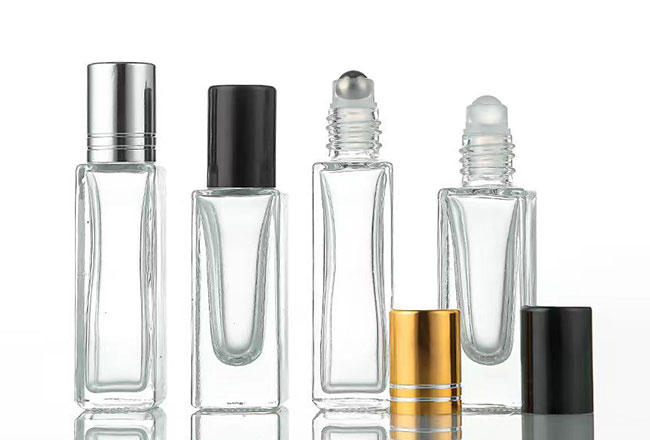
Quick answer: Custom roll on glass bottles are specified by three variables — capacity, roller ball material and diameter, and neck finish. Most brands start with a 10 ml bottle on a 16 mm neck finish for essential oils and roll-on fragrance, then move to 18–20 mm and wider necks for 30–50 ml deodorant and body-care formats. Use 316L stainless steel balls for low-viscosity oils, glass balls for luxury fragrance, and polypropylene balls for thicker gels. Expect a few hundred units MOQ on stock molds, and 10,000–50,000 units for bespoke molds or custom colors.
This guide covers sizing, ball selection, decoration, MOQ tiers and the leak-test criteria buyers should sign off before volume production starts.
Roll-On Packaging Demand: Why Brands Are Moving Beyond Deodorant
The roll-on format was once almost exclusively a deodorant pack. That is no longer true. According to Future Market Insights’ roll-on packaging market release, the global roll-on packaging market is projected to expand from USD 283.1 million in 2026 to USD 456.8 million by 2036, a 4.9% CAGR. FMI attributes that growth to beauty brands extending rolling applicators beyond conventional deodorant formats into skincare, fragrance and wellness applications that need controlled-contact dosing.
Roll-on packaging market snapshot (2026)
- USD 283.1 million — 2026 market value
- USD 456.8 million — projected value by 2036
- 4.9% CAGR — 2026–2036 growth rate
- 35.0% — share held by the 15–50 ml capacity segment
- 35.0% — share of end-use demand coming from skincare
- 44.0% — share of demand held by standard components
Source: Future Market Insights, roll-on packaging market release (2026).
Two signals in that data matter for buyers sourcing glass. First, standard components account for 44.0% of product type demand in 2026 — brands still prefer established neck, ball and closure interfaces because they avoid tooling changes and keep filling and sealing qualification intact. Second, FMI reports the 15–50 ml capacity segment holding 35.0% of the market, which is exactly the band where glass dominates plastics on perceived quality while still staying portable.
The wider glass cosmetic bottle category is growing on the same curve. Grand View Research values the glass cosmetic bottle market at USD 3.5 billion in 2026, rising to USD 4.7 billion by 2033. SRS Packaging reinforced the trend at Cosmopack Asia in November 2025 with a 30 ml leak-proof glass roll-on bottle designed specifically for oils.
“Roll-on programs earn value from the interface between formula viscosity and the ball-fitment geometry that controls flow. Packaging teams should compare leakage results and line compatibility before paying for decoration or recycled-content claims that alter proven component tolerances.”
— Nandini Roy Choudhury, Principal Consultant, Future Market Insights
Roller Ball Bottle Sizes: How to Match Capacity to Your Formula
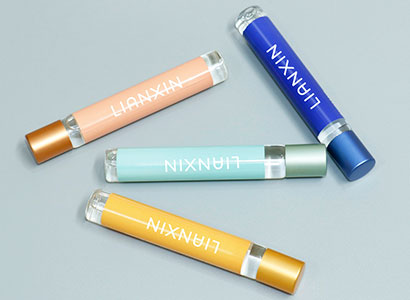
Sizing is the decision that drives everything downstream for glass roll on bottles — ball diameter, neck finish, filling line setup and retail price point. The 10 ml capacity remains the industry benchmark for essential oil and fragrance roller bottles: every major manufacturer produces it at volume, which keeps wholesale cost low and unlocks finishes such as amber, frosted and custom painting without punishing minimums. A standard 10 ml bottle holds roughly 200 drops, which makes dilution math simple — a 2% blend needs 4 drops of essential oil, a 5% blend needs 10.
Viscosity is the constraint most first-time buyers miss. A thin fractionated coconut oil sits near 30 cP and flows freely through a tight-tolerance steel ball. A thick castor-based or glycerin serum can approach 1000 cP and will stall in the same housing. Match the housing clearance to the fluid, not the other way around.
| Capacity | Typical neck finish | Recommended ball | Best-fit products |
|---|---|---|---|
| 2–3 ml | 10 mm | 6–8 mm steel | Samples, subscription boxes, travel sets |
| 5 ml | 13–16 mm | 8 mm steel | Concentrated eye serums, EDC fragrance |
| 10 ml | 16 mm (GL16 / DIN16) | 8–9 mm steel | Essential oil blends, roll-on perfume |
| 15 ml | 16–18 mm | 9–10 mm steel | Facial serums, beard and hair oils |
| 30 ml | 18–20 mm | 10–12 mm steel or PP | Facial oils, liquid foundation, primers |
| 50 ml | 20 mm and wider | ~25 mm (1 in) PP or glass | Roll-on deodorant, muscle rub, body oil |
Notice how the ball grows with the surface area it has to cover. Applying a full-body muscle rub through a tiny 8 mm ball frustrates the user; at 50 ml, roll-on deodorant formats typically use a ball close to an inch across so one swipe covers a wide swath. If your product line spans several sizes, standardise on the 16 mm neck where possible — it is the most widely supplied interface, so caps, fitments and labels stay interchangeable if a supplier runs short.
For fragrance and essential oil programs, pair your roller specification with a matching custom essential oil bottle program so the bottle, fitment and cap are qualified as one pack rather than three separate parts. Brands extending into pump-based formats usually review custom perfume bottle and atomiser options alongside the roller so the same glass body can serve both.
Roller Ball Materials: Stainless Steel, Glass or Plastic?
The ball is the part that touches the customer first, and it is also the part most likely to fail in transit. Three materials cover virtually every commercial program.
| Ball material | Best for | Watch-outs |
|---|---|---|
| 316L stainless steel | 5–15 ml oils, fragrance, eye serums | Specify 316L for citrus and camphor-heavy formulas — cheaper grades corrode |
| Glass | Luxury fragrance where the ball stays visible | Molding variance of roughly ±0.2 mm — undersized balls leak, oversized balls jam |
| PP / PE plastic | 30–50 ml deodorant, thick gels and emulsions | Reads as less premium; plasticiser and PCR documentation required |
Steel gives the tightest tolerance and a cooling sensation that suits eye serums and headache blends. Glass reads luxurious but is molded rather than machined, so the dimensional window is wider — that is why glass balls belong in short-run luxury fragrance, not in a high-speed filling environment where leak rates are measured per thousand. Plastic becomes the only practical choice once you pass 30 ml, because large-diameter steel balls are heavy and aggressively priced.
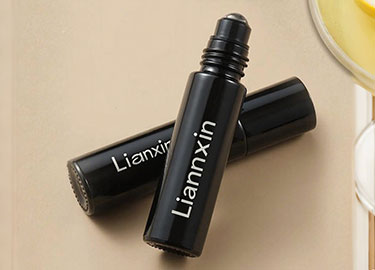
Decoration and Finishing Options for Glass Roll-On Bottles
Once the roller spec is proven, everything that follows is presentation — and this is where most custom roll on glass bottles earn their shelf premium. Decoration should come last in the approval sequence. FMI’s release is explicit that packaging teams should settle leakage, roller movement and sealing performance before spending on decoration or recycled-content claims that could alter established component tolerances.
- Amber and coloured glass — amber glass blocks the majority of UV light below 450 nm, which makes it mandatory for photosensitive cold-pressed citrus oils. Cobalt and emerald green offer moderate protection; clear glass offers almost none and usually needs a secondary carton.
- Frosted finishes — a soft-touch satin surface that diffuses light but provides little true UV blocking. Popular for skincare serums where the formula already sits in coloured glass.
- Color spraying — opaque painted finishes with Pantone matching, the fastest route to a distinctive shelf colour.
- Hot stamping and electroplating — metallic branding and mirror-finish collars for premium fragrance sets.
- Labeling and screen printing — note that a 2 ml body leaves almost no surface area for ingredient and warning text, which forces brands into printed outer cartons or blister packs. Confirm your regulatory copy fits before locking the smallest size.
Because buyers frequently combine several of these techniques on one pack, it helps to review the full glass bottle customization range alongside your sizing decision, and to request a decorated sample rather than judging a finish from a photo.
What Is the MOQ for Custom Roll On Glass Bottles?
Roll on bottle MOQ is the question buyers raise before anything else, and the answer scales with how far your spec departs from a stock item. Standard 10 ml rollers benefit from enormous global demand, so they can often be purchased in cases of a few hundred units. Non-standard sizes, slimline profiles and custom colours are a different economic equation, because the manufacturer must amortise tooling and colour setup across the run.
| Specification route | Typical MOQ | Lead-time driver |
|---|---|---|
| Stock mold, stock colour | A few hundred units | Filling, capping, cartoning |
| Stock mold, custom colour or finish | Several thousand units | Colour matching and decoration setup |
| Bespoke mold or non-standard size | 10,000–50,000 units | Mold fabrication and sampling rounds |
Before committing to five figures of inventory, calculate whether your projected sales velocity justifies tying up capital in empty glass. Two levers reduce the number: choose a stock mold and customise with colour spraying or hot stamping instead of a new mold, or fund sampling first and validate sell-through with a small decorated run before scaling.
Quality Checks Before You Approve a Roll-On Bottle Order
Leakage is the number one complaint in roll-on programs, and it almost always traces back to the interface between formula and fitment rather than to the glass itself. Before signing off custom roll on glass bottles, run these checks on pre-production samples:
- Leak and seal test — cap the filled bottle, invert and hold, then run a transit simulation. Document results per size; a 10 ml pass says nothing about a 50 ml housing.
- Roller movement and dispensing rate — confirm the ball turns freely with your actual formula at its real viscosity, and measure how much product one stroke delivers.
- Neck finish and thread engagement — mismatched threads let the cap back off slightly, and that microscopic gap lets oil seep out in transit. Verify the fitment housing sits tight against the glass neck.
- Filling line compatibility — narrow 10 mm finishes may not accept standard nozzles, and tall slimline bodies need custom pucks so they do not tip on the conveyor.
- Transit protection — heavier 30–50 ml glass raises dimensional weight and breakage risk, so drop-test the secondary packaging, not just the bottle.
- Compliance documentation — the EU Packaging and Packaging Waste Regulation applies from 12 August 2026, and multi-part roll-on packs combining glass, ball, fitment and closure need a clear material declaration. Recycled-content and refill designs are advancing across the category, but they change component tolerances, so qualify them as a new pack rather than a drop-in substitution.
Frequently Asked Questions About Roll-On Bottle Sourcing
What is the standard size for essential oil roller bottles?
10 ml on a 16 mm neck finish is the de facto standard for custom roll on glass bottles. It carries the industry’s lowest wholesale cost, the widest range of stock colours and finishes, and enough volume for roughly 200 drops of a diluted blend.
How many drops fit in a 10 ml roller bottle?
Approximately 200 drops. That makes dilution straightforward to document: 2% equals about 4 drops of essential oil, 5% equals about 10 drops, which is convenient for both production batches and consumer-facing recipe content.
Are glass roller bottles allowed in carry-on luggage?
Yes. Common 5 ml, 10 ml and 30 ml bottles all sit well under the 3.4 oz (100 ml) liquid limit, which is one reason micro and small sizes keep growing in sample and travel programs.
Ready to spec your roll-on bottle?
Send us your target capacity, formula viscosity and ball preference — we will return a decorated sample, a leak-test report and a written quotation against your volume.
Sources: Future Market Insights, roll-on packaging market release, 2026; Grand View Research, glass cosmetic bottle market report, 2026. Product specifications reflect Lianxin Glass Packaging’s standard manufacturing ranges — confirm exact tolerances and MOQ against your project brief.