Quick answer: Most custom nail polish bottles are produced in 5ml, 8ml, 10ml, 15ml and 20ml capacities. An 11–15ml flint glass bottle with a screw-thread neck and a flat, high-density brush is the industry standard for both regular and UV gel polish. MOQ for a fully custom-decorated run typically starts at 3,000–10,000 pieces, while stock moulds with printed decoration can ship from as low as 1,000 pieces.
Sourcing custom nail polish bottles is one of the first packaging decisions a new nail brand makes — and one of the hardest to reverse. The bottle you pick fixes your fill volume, brush performance, cap tooling, decoration route and landed cost per unit. Get it right and your formula applies cleanly, ships without leaking and photographs well on a retail shelf. Get it wrong and you spend the next two years repacking, reformulating or absorbing breakage claims.
This guide covers the specifications that matter most to buyers: capacities, brush types, glass versus plastic, neck finishes, decoration, MOQ and supplier verification.
Nail polish packaging market at a glance
- USD 19.7 billion — global nail polish market size in 2026
- 6.7% CAGR — projected growth to USD 31.0 billion by 2033
- 38.9% — Asia Pacific share of global nail polish revenue in 2025
- 46.9% — share held by regular nail polish; UV gel is the fastest-growing product segment at 7.8% CAGR
- 43% of consumers who do their nails do so exclusively at home — driving demand for consumer-sized bottles
Source: Grand View Research, Nail Polish Market Size, Share & Trends Analysis Report, 2026–2033
What Are the Standard Nail Polish Bottle Sizes?
Capacity is the first specification to lock when you buy custom nail polish bottles. It sets the fill volume your formula must be dosed to, the brush length you can use, and how the bottle sits in a retail display or an e-commerce mailer. The working range for mass-market polish is 5ml to 15ml; anything above 20ml is usually a professional salon or bulk-refill format.
Two numbers matter on a specification sheet: the overflow capacity (total volume the bottle physically holds) and the fill volume (what you actually dose, typically 85–92% of overflow to leave headspace for the brush and to prevent thermal expansion leaks). Always confirm which figure a supplier is quoting.
| Capacity | Typical use | Common bottle style | Approx. fill volume |
|---|---|---|---|
| 3–5ml | Sample kits, travel size, nail art gel | Round or square, short neck | 0.10–0.17 fl oz |
| 8ml | Entry SKUs, mini lines, gift sets | Round, slim square | ~0.27 fl oz |
| 10ml | Gel polish, indie brands, colour extensions | Square or round | ~0.34 fl oz |
| 12–13ml | Regional standard (EU, Asia) | Square, rectangular | 0.40–0.44 fl oz |
| 15ml | Mainstream retail and salon standard | Square or round | ~0.50 fl oz |
| 20–30ml | Professional refill, remover, treatment | Tall round, wide base | 0.68–1.0 fl oz |
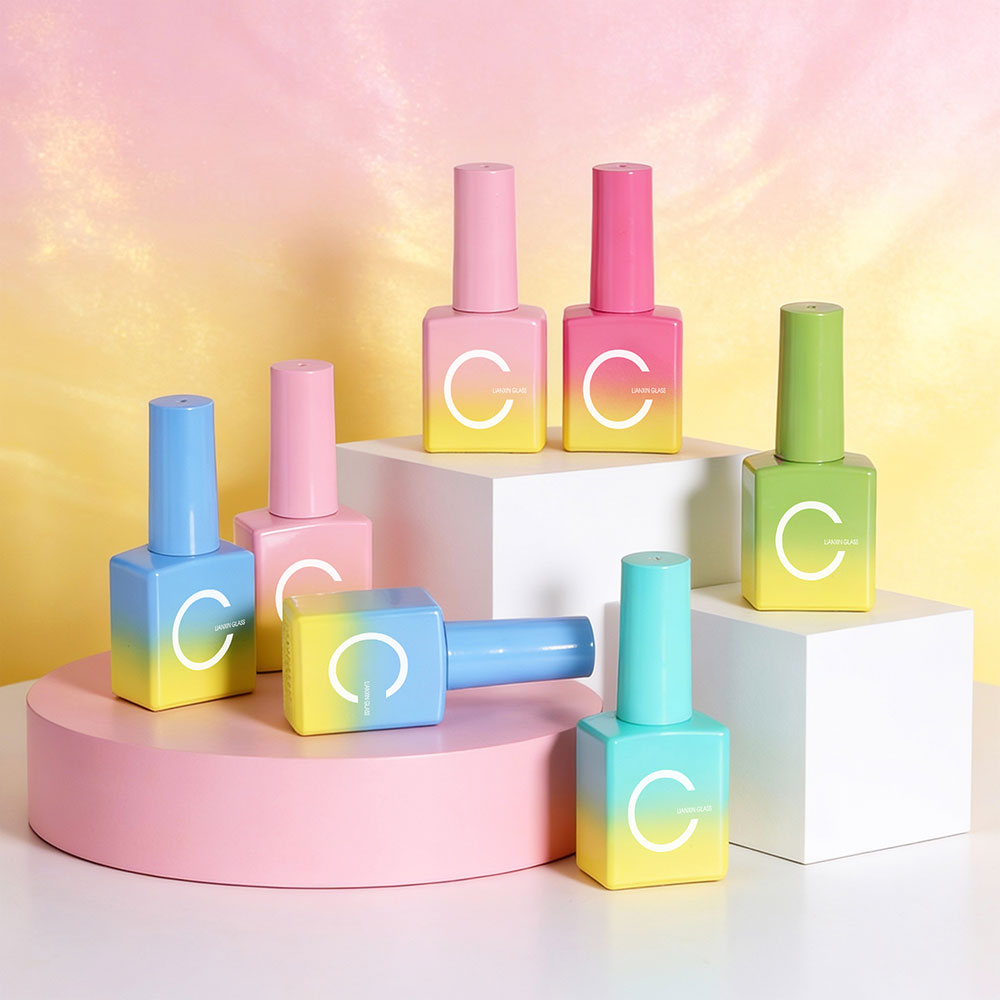
If you are launching a first range, the practical default is a 10ml or 15ml square bottle: it offers the most shelf presence per gram of glass, takes standard brushes and caps, and sits inside the same mould family as smaller sizes so you can extend the line later without new tooling. Browse our full range of glass nail polish bottles, which covers more than 3,000 specifications from 5ml to 20ml.
Nail Polish Brush Types: Matching the Brush to Your Formula
The brush is the part of the package your customer touches every single time. It is also the most common source of complaints — streaking, fanning, dripping, or a brush that will not reach the bottom of the bottle. Brush selection depends on formulation viscosity, not on branding.
| Brush type | Best for | Key spec |
|---|---|---|
| Flat oval | Most regular polish and gel; the default | High bristle density, rounded tip |
| Round | Thin, low-viscosity formulas and treatments | Lower pick-up volume, finer control |
| Flat / wide | High-viscosity gel, one-coat coverage | Wider spread, faster application |
| Tapered dome | Precision nail art, cuticle work | Narrow tip, short trim |
Two failure modes are worth planning around. First, a brush that is too short relative to fill volume leaves product stranded at the bottom of the bottle — always ask for a brush-length check against your maximum fill line. Second, an under-trimmed brush holds too much product and drips onto the cap thread, which is how dried-out bottles and stuck caps happen. Ask your supplier for a brush-and-wiper fit test on the exact bottle you are ordering, not on a lookalike.
Glass vs Plastic Nail Polish Bottles: Which Should You Choose?
Glass dominates the category for good reasons: it is chemically inert, so it will not react with solvents such as ethyl acetate; it offers an excellent barrier against moisture and oxygen; it is infinitely recyclable; and it signals premium quality. The trade-offs are weight, higher freight cost and breakage risk in transit.
Plastic formats — typically PP or PET — win on shatter resistance, lower unit cost at small volumes and lighter shipping. They are a reasonable choice for silicone-based nail treatments, remover bottles and travel formats. For decorative polish, however, plastic struggles with two things buyers care about: solvent permeation over shelf life, and the perceived quality gap at the point of sale.
One technical note for gel brands: UV gel formulations cure under light, so the container must block UV transmission. Flint glass with an opaque colour spraying or a solid coating is the standard solution, and the same finish doubles as a branding surface.
Caps, Neck Finishes and Leak Prevention
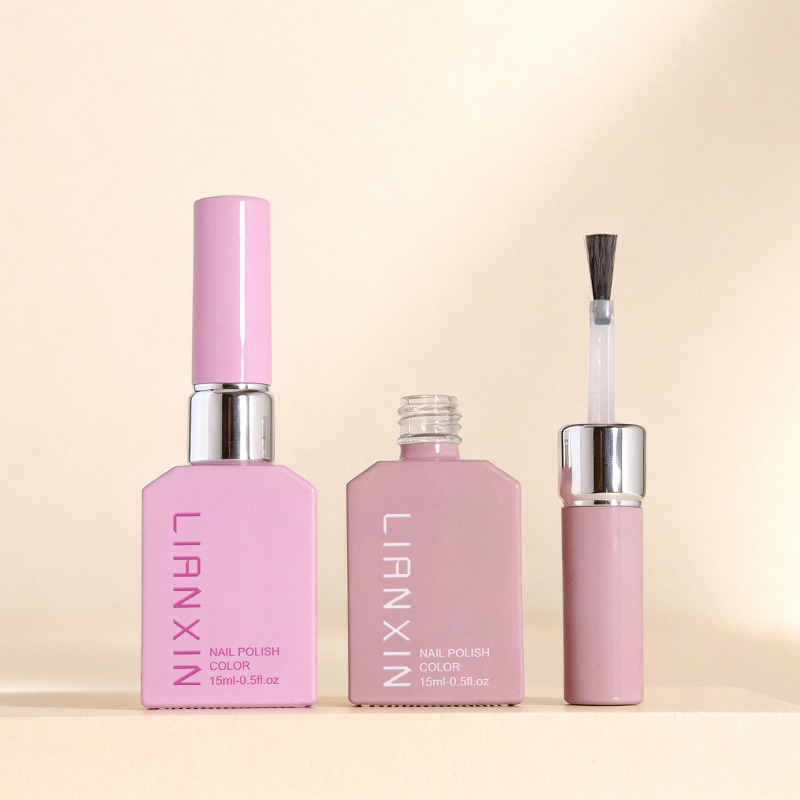
On custom nail polish bottles, the cap assembly is where most leak and dry-out complaints originate. A complete assembly has four parts that must be specified together: the bottle neck finish, the brush insert, the wiper, and the outer cap.
- Neck finish — expressed as a thread diameter and style (for example 13/415 or 15/415). The neck must match the cap exactly; a half-millimetre mismatch produces a slow seep that only shows up after shipping.
- Wiper — scrapes excess product off the brush as it is withdrawn. Wiper diameter should be tuned to formula viscosity.
- Brush insert — must grip the brush stem without slipping under torque.
- Outer cap — PP for a simple functional cap, or an ABS shell with a decorative overcap for premium lines.
Before approving a sample, run a leak test at 45 °C for 48 hours and a cap-removal torque check after that exposure. Solvent attack softens some liner materials and the cap that felt tight at room temperature may spin freely after a container sitting in a summer warehouse.
Decoration Options for Custom Nail Polish Bottles
Decoration is where custom nail polish bottles earn their shelf presence — and where cost varies most. The main routes are:
- Frosted glass — an acid-etched matte surface that diffuses colour and feels soft to the touch. Ideal for pastel, minimalist and clean-beauty lines.
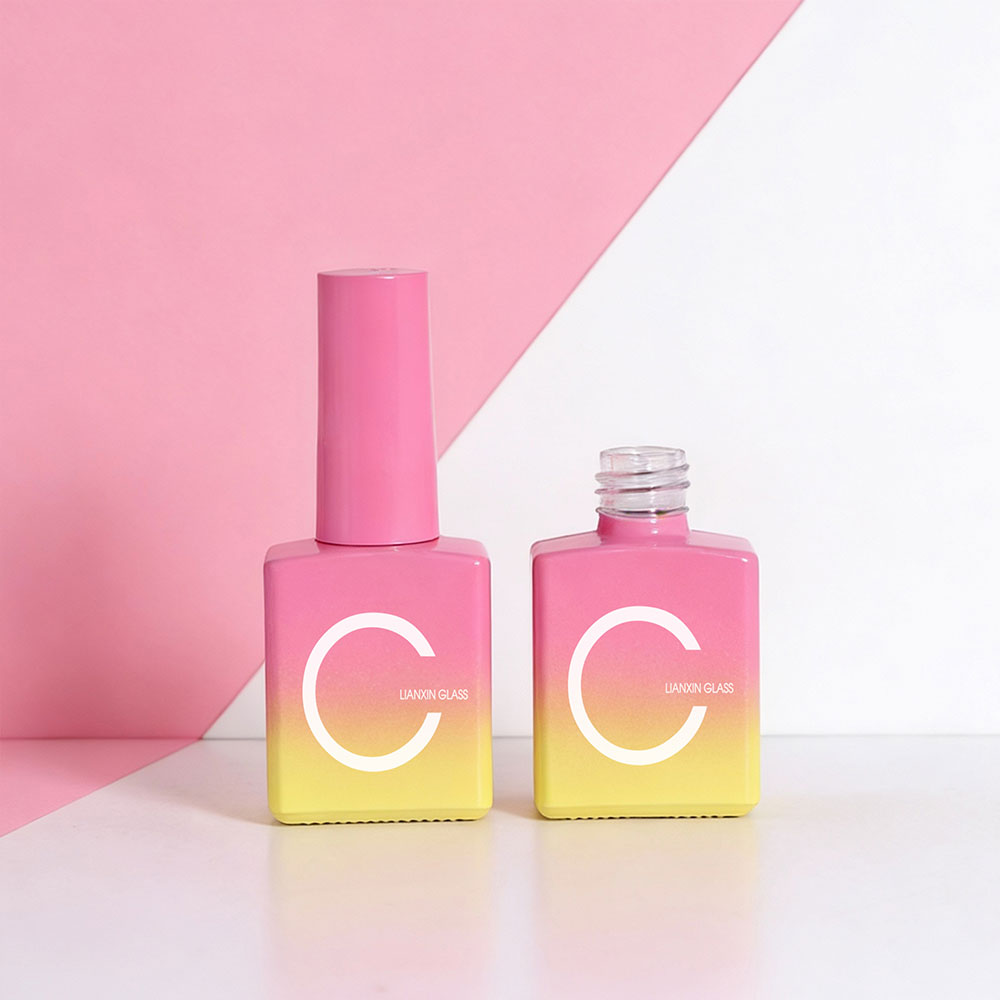
- Colour spraying — an opaque or gradient lacquer applied to the exterior. This is the standard route for UV gel bottles that need light blocking, and it supports gradients that printed labels cannot match.
- Hot stamping — metallic foil applied under heat and pressure. It reads as luxury on caps and shoulders, and works well for logos with fine detail.
- Screen and UV printing — the lowest-cost way to add a logo, net content or compliance text directly to the glass or cap.
- Flocking on caps — a velvet-touch finish that changes how the cap feels in hand, useful when competing on tactile quality.
If you need an exact brand colour, request custom colour matching against a Pantone reference rather than relying on a description. And if you are combining several finishes on one SKU, ask for a full customization sample so you can approve the finished combination, not each step in isolation.
What Is the MOQ for Custom Nail Polish Bottles?
MOQ for custom nail polish bottles is determined by whether your bottle uses an existing mould or requires a new one. Stock moulds carry the lowest minimums because no tooling investment is needed; a bespoke shape requires a mould that must be amortised across the order.
| Order type | Typical MOQ | Lead time |
|---|---|---|
| Stock bottle, no decoration | 1,000–3,000 pcs | 3–7 days |
| Stock bottle + printing or spraying | 3,000–5,000 pcs | 10–20 days |
| Stock bottle + multi-step decoration | 5,000–10,000 pcs | 20–30 days |
| Custom mould (new shape) | 10,000–30,000 pcs | 35–60 days |
For a new brand, the fastest route to market is a stock mould with a printed or sprayed finish: you get a differentiated look without tooling cost, and you can reinvest the saved budget into a second colourway. Review the trade-off between tooling investment and unit price before committing to a bespoke shape.
How to Evaluate a Nail Polish Bottle Supplier
Nail polish packaging is a regulated cosmetic contact material, so supplier evaluation is not only about price. Work through this checklist before placing a production order:
- Compliance documentation — confirm the supplier holds material certifications such as ROHS, REACH and CE, and that test reports reference the specific glass and coating you are buying, not a generic family certificate.
- Quality sampling standard — ask which AQL plan is used for critical, major and minor defects. You want the sampling plan named in writing before production, not after a dispute.
- Dimensional tolerance — request the tolerance range for neck finish diameter and height. This is what determines whether third-party caps and brushes will fit.
- Sample protocol — a serious supplier provides a pre-production sample with your decoration applied; a weak one ships a plain bottle and promises the rest.
- Fill-line and leak testing — verify that a filled sample survives transit simulation and elevated-temperature storage without seepage.
- Capacity verification — check the actual measured volume of the delivered bottle against the specification, since a routine change in glass weight can shift overflow capacity.
Ask for two references from brands of a similar size. Suppliers serving large accounts sometimes treat small custom runs as filler production, and lead times slip.
Why Glass Demand for Cosmetics Keeps Growing
The broader packaging picture supports a long-term shift toward glass. Mordor Intelligence puts the global glass packaging market at 132.06 million tons in 2026, growing to 154.86 million tons by 2031 at a 3.24% CAGR, with bottles and jars accounting for 64.55% of 2025 volumes and flint the dominant colour at 45.05%. Demand from the cosmetics industry for premium packaging is listed among the market’s growth drivers.
Regulation is reinforcing the trend. The EU’s Packaging and Packaging Waste Regulation, Regulation (EU) 2025/40, entered into force in February 2025 and applies from 12 August 2026, harmonising design-for-recycling and labelling rules across member states. For nail brands selling into Europe, a recyclable, single-material glass bottle with a compliant label is no longer a marketing preference — it is a design requirement. Small formats under 200ml — the volume band that covers perfume, travel-size cosmetics and nail polish — remain a high-value segment within the glass packaging market.
Sources: Grand View Research, Nail Polish Market Size, Share & Trends Analysis Report, 2026–2033; Mordor Intelligence, Glass Packaging Market Size & Share Analysis.
Next Step: Spec Your Bottle in One Conversation
The fastest way to move from specification to sample is to send four things: your target capacity, the formulation type (regular, gel or treatment), your decoration direction, and your first-order quantity. With those, we can tell you within a day which mould fits, whether a custom shape is worth the tooling, and what your per-unit cost lands at in each scenario.
We produce custom nail polish bottles from 5ml to 20ml in clear, frosted, sprayed and painted finishes, with matched brushes, wipers and caps, and we hold ROHS, REACH and CE certification across the range. Explore the full nail polish bottle collection or contact our team with your specification.