A custom glass bottle specification is the single document that decides whether your order arrives on time, on budget and on brand. In short, a complete spec sheet fixes nine technical facts — capacity, dimensions, glass type and colour, weight, neck finish, closure, decoration, packing method and quantity — plus the version control that stops a revision from becoming a production error. Miss one of them and your quotation becomes an estimate instead of a commitment. The distinction is worth real money: the global container glass market was valued at USD 83.35 billion in 2025 and is forecast to reach USD 144.33 billion by 2035 at a 5.64% CAGR, with bottles taking 65.7% of revenue (Market.us, Container Glass Market, June 2026). More brands enter that market every quarter — and the fastest to leave are those whose suppliers had to guess what they wanted.
What Is a Custom Glass Bottle Specification Sheet?
A custom glass bottle specification sheet is the controlled document that translates a brand’s design intent into manufacturable numbers. It is not a mood board and it is not a drawing alone: it is the working reference that the mould shop, the forming line, the decoration department, the inspection team and the freight forwarder all read. When an order arrives “slightly different”, the investigation almost always ends at an ambiguous line in the spec.
Specialist suppliers describe the sheet in the same terms: a specification records capacity, dimensions, neck finish, glass colour, weight, closure type, decoration, packing method and quantity (Bottlix glass packaging specification guidance). Treat those nine items as the non-negotiable core, then layer two more blocks on top:
- Decoration and artwork block — process, coverage area, number of colours, artwork file reference and colour tolerance.
- Packing and logistics block — inner carton, dividers, cushioning, pallet pattern, carton count and loading plan.
Experienced buyers add document control as well: a document number, revision number, issue date and named approver, because a specification without version control cannot be audited once a third revision reaches the factory floor (Xuelei quote comparison guidance). Packing specifications follow the same logic, usually split into primary, secondary and transport levels with their own template fields (OptimizingPack packing specification reference).
The 12 Fields Every Custom Glass Bottle Specification Must Include
Below is the field structure we recommend to brands opening a new cosmetic glass bottle program. The third column shows the level of precision that produces an accurate quotation instead of a range.
| Field | What to state | Worked example |
|---|---|---|
| 1. Capacity | Nominal fill and brimful capacity in ml and fl oz | 50 ml nominal / 56 ml brimful |
| 2. Dimensions | Body diameter, overall height, shoulder profile, with tolerance | D 38 mm x H 92 mm, +/-0.5 mm |
| 3. Neck finish | GPI or SPI code, thread type or crimp specification | 18/415 screw or 15 mm crimp |
| 4. Glass type and colour | Soda-lime or borosilicate; flint, amber, cobalt; coating or none | Soda-lime flint, matte black coating |
| 5. Bottle weight | Target weight in grams and acceptable weight range | 120 g target, 114–126 g range |
| 6. Closure | Type, material, lining, colour; child-resistant or tamper-evident if required | Fine mist sprayer, FEA 15 gasket |
| 7. Decoration | Process, coverage, colour count, artwork reference, colour tolerance | Frosted + 1-colour screen print, ΔE ≤ 2 |
| 8. Packing method | Inner carton, dividers, cushioning, pcs per carton, pallet pattern | 100 pcs/carton, 5-layer export carton |
| 9. Quantity | Pieces per SKU and per colour, plus over/under run tolerance | 10,000 pcs, +/-5% run tolerance |
| 10. Labelling | Label size, placement, application (hand or automatic), barcode | 50 x 30 mm front label, auto-applied |
| 11. Compliance | Target market, required test reports and documentation | EU market: REACH and PPWR recyclability |
| 12. Document control | Document number, revision, date, approval, Incoterm | SPEC-LX-014 rev 3, FOB Ningbo |
Why the compliance line matters more in 2026
Regulation (EU) 2025/40 (PPWR) entered into force on 11 February 2025 and becomes fully applicable on 12 August 2026, with all packaging required to be recyclable by 2030. Glass already qualifies on recyclability, but the regulation pushes brands to document recycled content and pack design choices — so the compliance field on your spec sheet is now an audit trail, not a formality (Market.us).
A practical shortcut: build the sheet once in a spreadsheet and keep the twelve rows fixed, changing only the values per project, so the factory receives the same structure every time and can flag gaps immediately. Ask your glass bottle manufacturer to return the sheet completed with their proposal. If the profile is genuinely new, start from our glass bottle customization program rather than a blank page.
What Is the MOQ for Custom Glass Bottles? Write It Into the Spec
Glass bottle MOQ is a specification field, not a negotiating afterthought, and the number moves with the mould route you choose. Reference ranges for export programs on stock moulds are 2,000–5,000 pieces for perfume flacons, 3,000–5,000 pieces for dropper and spray bottles, and around 10,000 pieces for modified stock, while a fully private mould typically starts at 30,000 pieces per run.
| Mould route | Typical starting MOQ | How to write it on the spec sheet |
|---|---|---|
| Stock mould | 2,000–5,000 pcs | State catalogue model number plus your colour and closure |
| Modified stock | About 10,000 pcs | State which element changes: neck finish, shoulder or embossing |
| Private mould | 30,000+ pcs per run | Attach the 3D file, tooling owner and exclusivity period |
Two MOQ traps belong on the sheet as well:
- Component minimums — the pump, dropper or cap assembly you chose in field 6 carries its own threshold, and that minimum, not the glass, is frequently the binding constraint on the whole program.
- Colour minimums — flint and amber run continuously, while specialty shades are batched into scheduled colour windows, so your minimum depends partly on what else is in the furnace that week.
If your forecast is modest, a custom colour coating on a standard flint bottle often delivers the shade you want at a stock-mould minimum.
The ordering rule is simple: put the target quantity, the per-SKU split and the acceptable run tolerance on the sheet before you ask for a price. Suppliers who receive a firm quantity quote firm numbers.
Neck Finish, Capacity and Weight: The Three Specifications That Cause Most Rejections
Three fields generate the majority of production disputes, because each one has a hidden second meaning that inexperienced buyers omit.
Neck finish is a dimensional standard, not a description. Writing “18 mm neck” is not enough — 18/415, 20/410 and a 15 mm crimp neck are different interfaces, and only the correct GPI or SPI code guarantees that your closure seats, seals and survives transit without leaking. Specify the code and, for fragrance work, whether the pump is crimped or screwed: our guide to custom perfume bottles covers how that choice changes both tooling and filling equipment.
Capacity has two values. Nominal capacity is the declared fill volume on your label; brimful capacity is the physical volume to the rim. A 50 ml nominal bottle typically holds about 56 ml brimful, and the gap between them is headspace — the buffer that absorbs thermal expansion and protects the pump dip tube. Put both figures on the sheet, plus the fill level your filler will target.
Weight is where freight cost and premium perception collide. A lighter bottle cuts transport cost and glass consumption, and the industry’s Narrow Neck Press and Blow forming method can reduce glass weight by 20–30% without losing structural integrity (Market.us). But weight also signals quality at retail, and it changes how a label applies. Decide deliberately: state a target weight in grams plus a tolerance band.
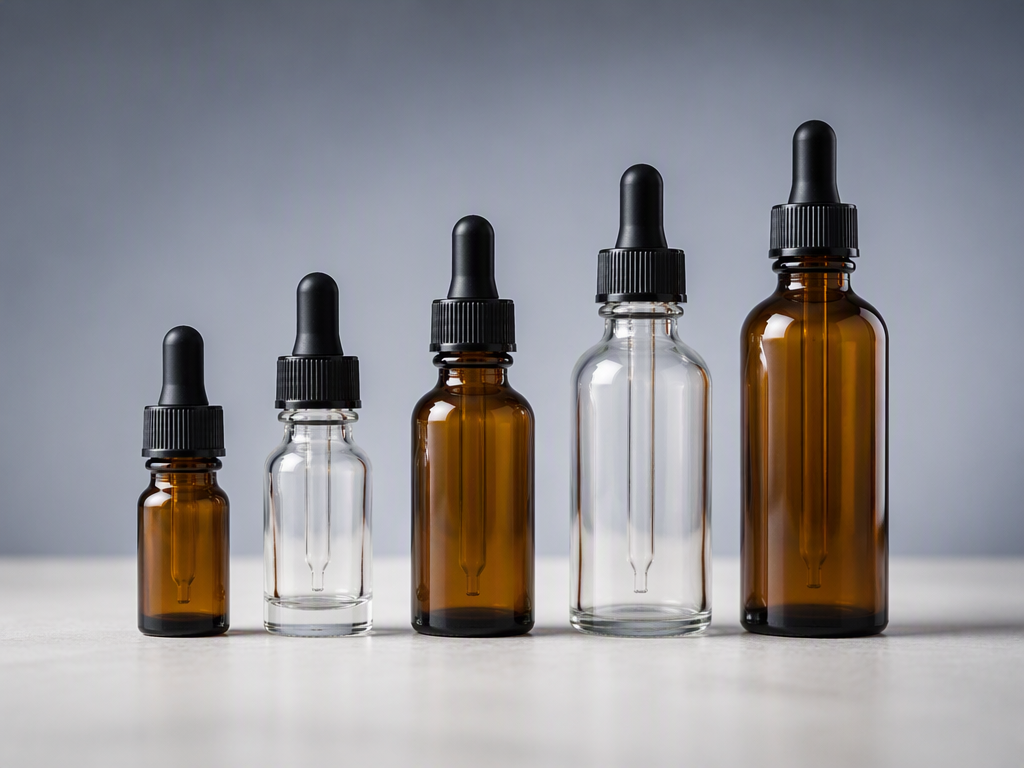
One further field pair matters for skincare: if your line includes essential oil bottles or serum formats, specify the pipette length and the orifice size together with the bottle weight, because a dropper that reaches only two-thirds into the bottle changes your declared dose per use. Decoration specifications deserve the same precision: a frosted finish or a hot stamped logo needs a coverage area and a colour tolerance, not just a process name.
- Write codes, not adjectives. “Standard neck” and “premium weight” are not specifications; a GPI code and a gram figure are.
- Give every number a tolerance. A target without a range invites a dispute at goods-in inspection.
- Name the reference sample. State the sample number that defines the approved look, weight and finish, so the bulk run is judged against a physical object rather than a photograph.
How to Write a Glass Bottle RFQ That Returns an Accurate Quote
The specification sheet is the input; the request for quotation is the message you attach it to. A decision-ready RFQ contains, in this order:
- Program summary — product family, launch date and annual forecast, so the supplier can place you in a production window rather than guess.
- The completed glass bottle spec sheet — all twelve fields, every row filled or explicitly marked as open.
- Quantity split — pieces per size, per colour and per decoration variant, including any variant you will add in year two.
- Closure and decoration scope — what you buy from this supplier and what you source elsewhere, so nothing is double-quoted.
- Packing and shipping requirements — export carton standard, pallet preference, destination port and Incoterm, because cushioning rules for fragile glass and container loading maths change the landed cost as much as the bottle price does (OptimizingPack).
- Compliance and documentation — target market, test reports required, and whether you need recycled-content evidence.
- Approval path — who signs the sample off, and how many rounds your timeline allows.
Questions a good supplier will ask you back. Is your bottle a stock model or a new mould? What is the MOQ for each component, not just the glass? Which market will the product be sold in, and which test reports do you need? How many decoration variants are planned? Answer these once, in writing, and the quotation stops moving.
Expect the first quotation to contain assumptions. Read that list as a checklist of what your spec sheet left open and close each item in writing; the quotation will then hold through tooling and production. That is far cheaper than discovering a mismatch after the bulk run ships.
Summary: Build the Spec Sheet Once, Reuse It for Every Order
A custom glass bottle specification turns a design idea into a document a factory can execute. Fix the twelve fields, control the revision, state capacity both ways, lock the neck finish by code, decide weight deliberately, and attach the sheet to every RFQ you send. Do that and your quotation stops being an estimate, your sample becomes the production reference, and your next order starts from data instead of memory.
If you would rather not build the sheet from scratch, send us your bottle family, target capacity, closure direction and forecast quantity. Our packaging engineers will return a completed specification with current MOQ, colour windows and packing options. Talk to our packaging engineers and we will check your specification line by line before tooling begins.