Sourcing cosmetic jars wholesale in 2026? Here is the direct answer before the details: pick a capacity that matches your product (15g for eye creams, 30–50g for standard face creams, 100g and above for body butters), choose glass when your brand competes on premium feel or refillable design, and expect a minimum order quantity of roughly 1,000–5,000 units once you add custom color or logo decoration. The category is growing steadily — Future Market Insights values the global cosmetic jars market at USD 5.0 billion in 2026 and projects it to reach USD 7.6 billion by 2036, with skincare representing about 60% of jar demand. This guide tells you exactly what to specify, compare, and ask for before you request quotes from a cosmetic jar manufacturer.
Key takeaways for buyers
- Skincare drives ~60% of cosmetic jar demand (face creams and moisturizers are the largest category).
- Glass jars cost roughly 2–4x more than plastic per unit, but dominate premium, refillable and natural positioning.
- Medium-capacity jars around 30–100ml are the market core; small jars below 50ml serve eye creams and samples.
- Custom decoration (frosting, color, logo) typically lifts MOQs to the 1,000–5,000 unit range for indie launches.
Why Cosmetic Jars Wholesale Demand Keeps Growing
Jar packaging is not a commodity line item — it is where skincare brands protect sensitive formulas and communicate shelf identity. Future Market Insights reports that the cosmetic jars market expands at a 4.3% CAGR from 2026 to 2036, while separate research from Toward Packaging sizes skincare primary packaging at USD 5.14 billion in 2026, heading to USD 8.51 billion by 2035 (5.75% CAGR), with face creams and moisturizers alone holding 28% of product-category demand.
Market snapshot behind today’s jar sourcing
- USD 5.0B — global cosmetic jars market, 2026 (Future Market Insights)
- 4.3% — projected CAGR, 2026–2036
- 60% — share of jar demand from skincare applications
- 28% — share of skincare packaging demand from face creams & moisturizers (Toward Packaging, 2025)
- 5.8% — China’s projected CAGR, the fastest-growing major sourcing hub
Three forces explain the growth. First, multi-step skincare routines keep adding jar-packaged SKUs such as night creams, treatment masks and eye creams. Second, indie and clean beauty brands are launching through DTC, Amazon and TikTok Shop and need flexible suppliers with lower minimums and custom decoration — the fastest-growing end-user segment. Third, sustainability commitments are pushing refillable glass and recycled-content formats into mainstream specifications. If you sell creams, balms, masks or body butters, wholesale cosmetic jars are a category worth planning carefully rather than buying on price alone.
Glass vs. Plastic Cosmetic Jars: Which Should You Choose?
The material decision shapes your unit cost, brand perception and sustainability story. Plastic (PET, PP, acrylic) is expected to hold about 55% of the product segment in 2026, according to FMI, because it is light, shatter-resistant and cheap to ship — a practical choice for mass-market lines. Glass is the opposite end of the spectrum: FMI estimates glass jar unit costs run 2 to 4 times higher than plastic, which is why glass dominates luxury skincare where weight, tactile feel and refillable design justify the premium.
| Comparison | Glass jars | Plastic jars |
|---|---|---|
| Perceived value | Premium, weighty, luxury feel | Practical, mass-market |
| Unit cost | 2–4x plastic (FMI) | Lowest, lightweight shipping |
| Formula protection | Excellent barrier vs. air and light (amber options) | Good; depends on resin and additives |
| Sustainability story | Recyclable, refillable-friendly | PCR options growing; lighter footprint in transit |
| Best fit | Premium skincare, clean beauty, refill systems | Drugstore lines, high-volume basics, travel sizes |
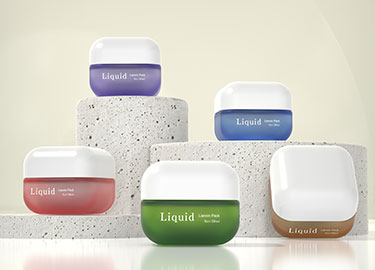
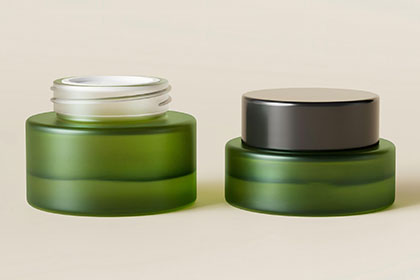
If you are leaning glass, the next decision is the finish. A frosted glass jar finish softens light and adds the matte, tactile quality that shoppers associate with premium skincare; clear glass shows off formula color; electroplated caps and accents add metallic depth without touching the glass itself. For regulatory markets, confirm your supplier’s documentation covers food-contact and cosmetic requirements such as FDA compliance for the US, REACH for the EU and RoHS where electronics-adjacent components are involved.
Cosmetic Jar Sizes: How to Match Capacity to Your Product
Jar size is usually specified in grams for creams and in milliliters for lighter formulas; for water-density products the two are close enough that 30ml and 30g jars share tooling families. FMI’s capacity analysis gives a practical map: small jars below 50ml serve eye creams, samples and gift sets; medium jars of roughly 30–100ml are the market core for daily face creams and moisturizers; large jars above 200ml cover body butters, hair masks and salon refills. In practice, most skincare brands order the sizes below.
| Jar size | Typical product | Sourcing notes |
|---|---|---|
| 15g | Eye cream, lip balm, deluxe samples | Often part of gift sets; small-capacity segment |
| 30g | Day cream, travel-size face cream | Popular for first launches and DTC trial pricing |
| 50g | Standard face cream, night cream, masks | The default hero size for moisturizer lines |
| 100g | Body cream, thicker treatments | Good price-per-gram perception |
| 200g+ | Body butter, hair masks, salon/bulk | Large-capacity segment per FMI |
Two practical rules keep your range manageable. First, standardize on one or two neck finishes so one closure family fits multiple capacities, which simplifies inventory and lowers cost. Second, remember that fill volume is not the same as jar capacity — leave headspace for overfill tolerance and for formulas that need an inner disk or seal. When in doubt, ask the supplier to send filled-sample photos or an actual sample kit before committing to a full run.
How to Customize Cosmetic Jars: Finishes, Colors and Decoration
Customization is where a stock jar becomes your brand asset — and whether you are sourcing stock containers or fully custom glass cream jars, the same rules apply: define finish and decoration before you negotiate MOQ. The options below are the ones B2B buyers ask about most, roughly ordered from highest to lowest visual impact:
- Frosted finish — matte acid-etched or spray-treated glass that hides fingerprints and reads instantly as premium; pairs well with almost any cap metal.
- Custom color matching — batch-matched glass tint or sprayed color (Pantone-matched) so the jar echoes your brand palette.
- Hot stamping decoration — metallic foil logos and lines (gold, silver, rose gold) applied to glass or caps for a crisp, reflective brand mark.
- Color spraying — full-body color coating for opaque, high-impact jars, often combined with a clear or printed window.
- Caps and liners — anodized or electroplated metal-look caps, wooden lids for natural lines, plus inner disks, droppers or spatulas.
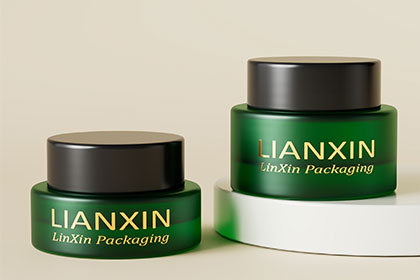
If your design is new, validate it before mold investment. A 3D-printed prototype lets you check the silhouette, cap fit and decoration placement in days rather than weeks, and most factories will apply the same finishing logic to jars as to bottles. Ask for a complete brief covering capacity, neck finish, cap type, decoration position and color references, then confirm the supplier can execute one-stop customization service — glass, decoration, caps and cartons from a single quality owner.
What Is the MOQ for Custom Cosmetic Jars, and How Do Samples Work?
The honest answer: MOQ depends on whether you use a stock jar or develop a custom mold. Stock designs with existing tooling carry the lowest minimums — many factories accept small trial orders so you can test the market. Custom-molded jars are different: the mold cost must be amortized across the production quantity, which pushes the MOQ up. For decorated stock jars, FMI notes that US indie brands typically source 1,000 to 5,000 units per launch with custom decoration — a realistic planning range for a first order with color and logo work.
“Rapid prototyping, lower minimum order quantities, and custom decoration for indie beauty brands are capturing the fastest-growing segment of jar procurement demand.” — Future Market Insights, Cosmetic Jars Market Analysis, 2026
Work through the sample stage in three steps. First, request a stock or printed sample to verify capacity, closure torque and decoration quality against your brand standard. Second, run a compatibility check — fill the jar with your actual formula and store it for 2–4 weeks to confirm no interaction, odor or weight loss. Third, agree on production lead time, payment terms and the AQL sampling plan (commonly ISO 2859-1) so that incoming QC at your warehouse matches the factory’s outgoing inspection. During this stage the fastest teams also lock the artwork files for decoration, because artwork approval is the most common cause of schedule slips.
Bottom Line: Buy Cosmetic Jars with a Specification, Not Just a Price
Wholesale cosmetic jars are a specification-driven purchase: capacity, material, finish, closure and compliance define both your shelf story and your landed cost. Start with a 50g glass jar in a frosted or custom color finish if you sell a standard face cream, validate with samples, and scale sizes around your core SKU. Whatever your launch size, work with a factory that shows you finished examples of the exact finish you want — and get every commitment (MOQ, lead time, QC standard) in writing.
Get a Free Quote for Custom Cosmetic Jars
Sources: Future Market Insights — Cosmetic Jars Market Report (2026–2036); Toward Packaging — Skincare Primary Packaging Market Sizing (2026–2035).