
Quick answer: glass bottle fill volume is the amount of liquid you can actually put into a bottle on a filling line, and it is always lower than the capacity printed in a catalogue. If your product must deliver 50 ml to the customer, you need a mould whose nominal capacity is 50 ml and a confirmed usable fill volume — at our factory, safe fill volume in moulded cosmetic bottles typically runs 5–10% below nominal capacity once headspace and closure displacement are accounted for.
This guide explains nominal capacity vs overflow capacity, how headspace in glass bottles is set, what a 50 ml bottle really holds, and how to lock fill volume into a purchase order so the glass, the pump and the label all agree.
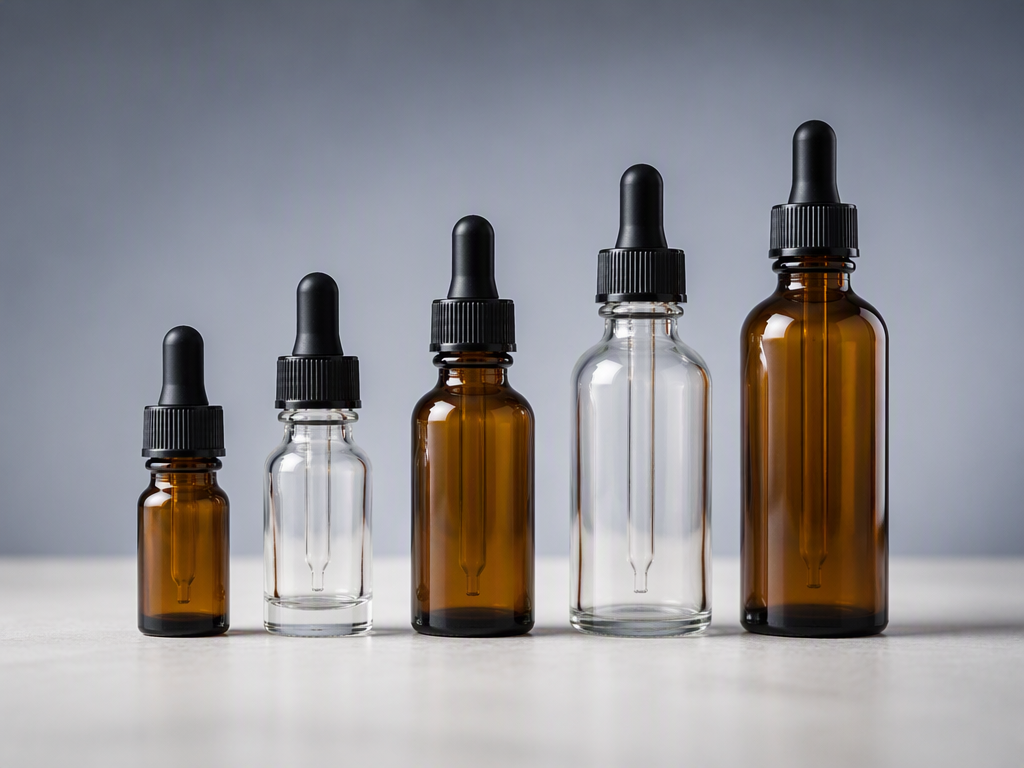
Demand for the products that sit inside these bottles keeps climbing. Grand View Research values the global cosmetics segment of the essential oils market at US$2,642.8 million in 2024, forecast to reach US$5,743.8 million by 2033 at a 9% CAGR — every additional litre of fragrance, serum and oil has to be poured into a container whose real fill capacity someone specified correctly.
What Is the Difference Between Nominal Capacity and Overflow Capacity?
Three different numbers hide behind the single word “capacity”, and confusing them is the most common reason a fill line runs short of product in the last hour of a shift.
| Term | Measured to | Where it is used | What it leaves out |
|---|---|---|---|
| Nominal capacity | A defined fill point below the rim | Catalogue size, mould drawing, box artwork | Closure displacement |
| Overflow (brimful) capacity | The very top of the neck, no closure | Technical data sheets, mould verification | Anything a filler can safely dispense |
| Usable fill volume | The dispensed quantity with headspace and closure in place | Purchase order, label claim, filling machine setpoint | Nothing — this is the number that matters |
US packager Encap puts the distinction bluntly in its own glass catalogue: “catalog mL values are not a fill-weight promise… usable volume depends on headspace and the filling method. Ask how the catalog capacity was measured.” That is exactly the question a buyer should put to a supplier before signing off a mould. On the technical side, our engineering team issues a drawing for each mould that states nominal capacity, the fill point height measured from the rim, and overflow capacity, so the two numbers can never be mixed up later.
“Catalog mL values are not a fill-weight promise: powders have different bulk densities, and usable volume depends on headspace and the filling method.” — Encap North America, glass bottles & jars brief
Why Your 50 ml Bottle Never Holds 50 ml: Headspace in Glass Bottles
Searches for “how much does a 50 ml bottle hold” almost always come from a brand that already filled a test batch and found the level sitting below the shoulder. Three things take up room inside a sealed bottle, and all three are permanent design decisions rather than filling errors.
- Headspace for expansion and closure travel. Liquids expand with temperature, and the space above the liquid lets a pump or dropper settle without pressurising the bottle and weeping through the seal.
- Closure displacement. An essential oil dropper bottle loses volume to the glass pipette hanging into the body. A pump with a long dip tube does the same on a lotion pack, and a roll-on insert displaces liquid at the shoulder.
- Glass weight tolerance. Moulded glass varies slightly in wall thickness from cavity to cavity, so internal volume drifts a little even when the outside dimensions look identical.
In practice, a 50 ml nominal dropper bottle typically receives 45–47 ml of product at our standard fill point, which is why UK fragrance house Shay & Blue can describe a 30 ml bottle as delivering 300–450 sprays rather than a fixed millilitre figure per use. Fragrance oils and alcohol-based perfumes usually sit around 0.85–0.95 g/ml, so a 50 ml fill also weighs noticeably less than 50 g — another reason to specify volume and weight separately on the same specification sheet.
If the outer silhouette matters more than capacity — short, wide-shouldered flacons, for example — the fill volume discussion should happen alongside the shape review. Our custom perfume bottle range is drawn up with a fill point marked on every render for this reason.
How Glass Bottle Fill Volume Changes Pump, Dropper and Spray Dosing
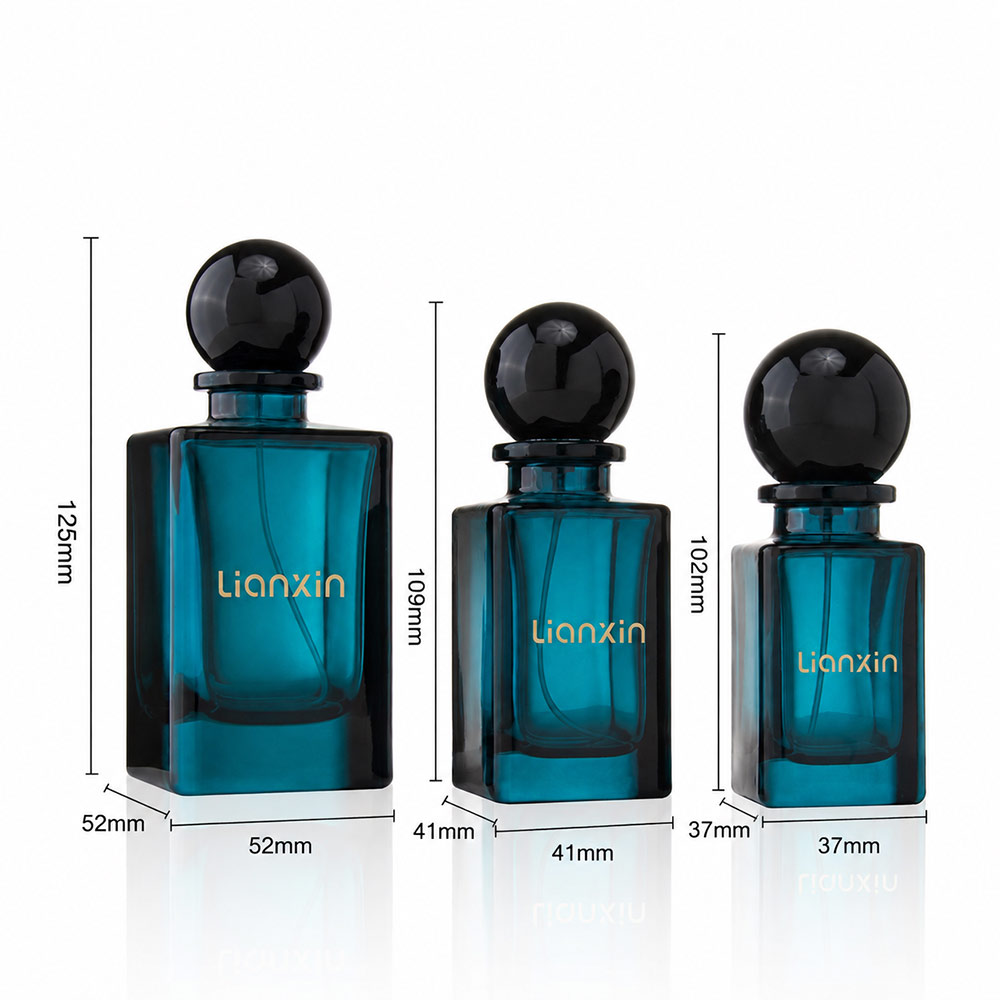
Fill volume is not only a packing decision; it sets the dosage experience. Work backwards from a published spray count and the dosing rate becomes visible: 30 ml producing 300–450 sprays works out to roughly 0.07–0.1 ml per actuation, while 100 ml producing 1,000–1,500 sprays lands in the same band. That rate is a property of the pump and the viscosity of the juice, not of the glass — but the bottle volume is what converts the rate into “about two months of daily wear” on a product page.
| Dispenser | What consumes usable fill volume | Spec detail to confirm |
|---|---|---|
| Fine-mist sprayer | Dip tube length, pump body height | Tube cut so it clears the base by 1–2 mm |
| Glass dropper | Pipette barrel and bulb seat | Pipette length for the exact body height, not the nominal size |
| Lotion pump | Pump engine, gasket and collar | Dose per stroke, suction tube seat depth |
| Brush cap | Brush length, wiper in the neck | Brush clearance so the cap seals without flooding |
Viscous products change the maths again. A nail polish bottle filled with a thixotropic lacquer has to leave enough air for the brush to agitate the pigment, whereas a water-thin toner can sit closer to the fill point. A drop-count table published by a dropper bottle supplier makes the spread obvious: it lists 5 ml at roughly 100–125 drops and 30 ml at 600–750 drops — an implied 20–25 drops per millilitre for low-viscosity oils. If your formula is thicker, expect fewer drops per millilitre and budget a larger bottle for the same number of uses.
Does Labelling Law Care About Glass Bottle Fill Volume?
Yes, but less than most buyers expect — and differently by market.
In the EU, Directive 2007/45/EC deregulated nominal quantities for the general FMCG categories, cosmetics included. Under Article 2(1) a Member State cannot refuse a prepacked cosmetic on grounds of its nominal quantity, so a 47 ml serum or a 73 ml oil is legally fine as long as the declaration is clear and truthful. Mandatory sizes survive only for wine and spirit drinks — spirits between 100 ml and 2,000 ml may be sold only in nine permitted volumes (100, 200, 350, 500, 700, 1,000, 1,500, 1,750 and 2,000 ml). That is why a 600 ml gin bottle is prohibited inside that range while a 50 ml miniature falls below the threshold and is fully deregulated.
In the United States, net content is policed through NIST Handbook 133, the procedural guide used by weights-and-measures inspectors to check that declared net quantity is accurate and that reasonable variation is controlled across the lot. The practical consequence for a bottle buyer is identical in both markets: the declared figure must be deliverable on average, from every cavity of the mould, at every fill point your contract filler uses.
How to Specify Glass Bottle Fill Volume on a Purchase Order
A specification sheet that lists only “50 ml” invites disputes. Add these fields and the ambiguity disappears:
| Field | Example wording | Why it matters |
|---|---|---|
| Nominal capacity | 50 ml ± 1 ml at 3 mm below rim | Gives inspectors and fillers a repeatable reference |
| Overflow capacity | 55 ml brimful minimum | Proves the mould has room for headspace |
| Closure stack | 18/410 crimp pump, tube length 62 mm | Stops components being sourced separately and mismatching |
| Target fill volume | 46 ml (+1 / −0.5 ml) at 20 °C | Matches the label claim and the batch yield |
| Decoration impact | External only — no internal coating | Keeps frosted finishes and custom colour spraying off the product-contact surface |
Run a line trial before bulk: fill ten bottles from the same cavity with your real product, cap them with the production closures, and weigh each one. Ten weights out of tolerance means the fill point in the drawing, not the machine, needs revisiting. Our customisation service covers mould review, sample bottles and closure matching in one loop so this test happens before tooling is cut.
Five Glass Bottle Fill Volume Mistakes That Reach the Production Line
- Naming the bottle by the liquid instead of the mould. A “50 ml” bottle is a 50 ml nominal mould; the product inside is whatever the fill point allows.
- Sourcing caps from a different supplier. A 24/400 cap on a 24/410 neck will bottom out on the shoulder before the liner seals, and the resulting leak gets blamed on fill volume.
- Ignoring dropper displacement when labelling. Selling a 30 ml bottle with a pipette inside and filling to 30 ml means overflowing once the closure is inserted.
- Quoting overflow capacity to the marketing team. Brimful figures flatter the product and then break the label claim.
- No temperature allowance. A product filled warm in summer and shipped cold contracts, leaving a visible air gap that customers read as underfill.
Final Thoughts
Glass bottle fill volume is a specification, not an assumption. Get the nominal capacity, overflow capacity and usable fill volume written onto the drawing, match the closure stack to the same document, and confirm it with ten weighed bottles before tooling is approved. Do that and the label, the pump and the filling line stop arguing with each other.
Need a fill volume verified on a specific mould before you order? Send the bottle reference, the closure you plan to use and the target net content — our engineers will return a marked-up drawing with the fill point and a recommendation on nominal capacity.
Sources: Grand View Research, Cosmetics — Essential Oils Market Statistics (market size and CAGR); fmcg.network, EU Nominal Quantity Rules: Directive 2007/45/EC (nominal quantity rules); NIST, Handbook 133 – Checking the Net Contents of Packaged Goods; Encap North America, glass bottles & jars brief (catalogue capacity caveat); Shay & Blue, Fragrance Bottle Sizes and Concentrations (sprays per bottle); Fomalhaut, Essential Oil Bottle Sizes: Drop Count Guide (drops per capacity).