

Quick answer: Glass bottle closure types fall into five families — fine-mist sprayers, lotion pumps, droppers, roll-on balls and brush caps. Which one you need is decided by three things: formula viscosity, the dose you want per use, and the neck finish on the bottle. Water-thin liquids belong in sprayers, thin oils and serums in droppers, lotions and gels in pumps, nail colour in brush caps. Settle the closure before you sign off the bottle drawing, never after.
Glass cosmetic bottles were worth USD 3.3 billion in 2025 and are projected to reach USD 4.7 billion by 2035 at a 3.5% CAGR, according to Future Market Insights. The same report gives dropper bottles 40.0% of product-type demand and skincare 45% of end use — a reminder that in this category the closure does as much commercial work as the glass itself. Understanding glass bottle closure types is therefore a purchasing decision, not a finishing detail: the wrong cap wastes formula, fails on the filling line, or quietly kills the premium feel you paid for. This guide compares the main closure families by dose, cost and neck fit, and shows how to lock the right one to your formula and bottle.
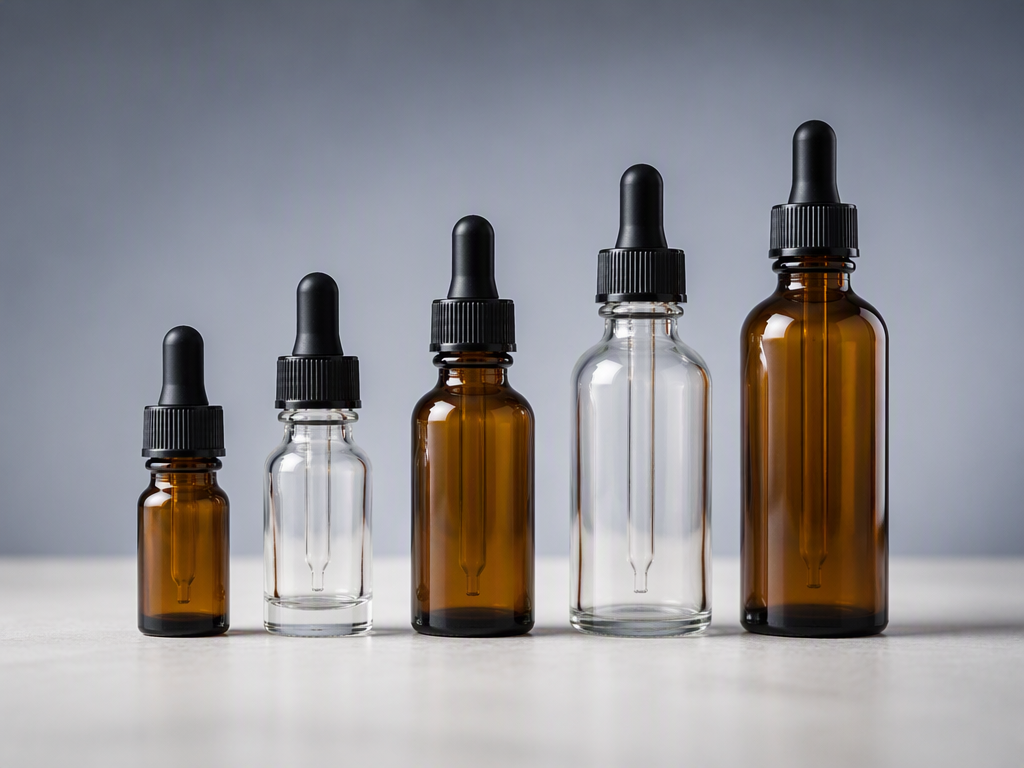
What are the main glass bottle closure types?
There are five glass bottle closure types used on cosmetic packaging, plus the airless pump as a premium variant. Each one changes how the user meets the product: a dropper releases drops, a pump releases a fixed dollop, a sprayer releases a mist, a roll-on deposits a film, and a brush cap coats an applicator. That difference in the dispensing action is what should drive your choice — not the cap’s silhouette or its decoration.
| Closure type | Dispensing action | Typical output | Typical unit cost |
|---|---|---|---|
| Fine-mist sprayer | Atomised mist | 0.10–0.15 ml per actuation | $0.08–0.20 |
| Lotion pump | Measured dollop | 0.5–2.0 ml per stroke | $0.08–0.25 |
| Dropper | Individual drops | 0.03–0.05 ml per drop | $0.10–0.40 |
| Roll-on ball | Film applied to skin | Depends on ball and formula | Quoted by closure spec |
| Brush cap | Product carried on bristles | Set by brush diameter | Quoted by closure spec |
Output and cost ranges in the table above follow published supplier pricing for these glass bottle closure types (Desiky comparison data). Treat them as planning bands for a first cost model, then confirm against samples: a 30 ml dropper and a 100 ml sprayer of the same nominal type rarely price identically.
Pump vs dropper vs sprayer: which closure fits your formula?
Among all glass bottle closure types, pumps, droppers and sprayers account for most cosmetic launches — and the deciding variable is viscosity. A dropper relies on gravity and capillary action, so it only works well on low-viscosity liquids that flow into the pipette. A pump draws product up a dip tube and forces it through a chamber, which is why it handles lotions, gels and creams a dropper cannot move. A sprayer needs a water-thin liquid that atomises cleanly; thicken the formula and you lose the mist and gain a sputter.
| Formula profile | Closure that works | Why |
|---|---|---|
| Water-thin toner, body mist, fragrance | Fine-mist sprayer | Even coverage over a wide area, no waste |
| Face oil, serum, tincture | Dropper | Small controlled dose, less air exposure |
| Lotion, gel, liquid soap | Lotion pump | Repeatable dose from a viscous base |
| Deodorant, eye serum | Roll-on ball | Direct skin contact, no fingertips |
| Nail polish, lip gloss | Brush cap | Applicator is part of the product experience |
Burch Bottle puts the same logic in operational terms: the closure should be selected against viscosity, application, dosage requirements and — critically — the bottle’s neck finish, dip tube length, seal requirement and material compatibility (Burch Bottle dispensing cap guide). In practice, the closure and the bottle have to be specified as one system. A 50 ml flacon with a beautiful 15 mm neck is a display object, not a product, if no stock sprayer fits it.

How much product does each closure deliver?
Dose per use is where glass bottle closure types stop being a design question and start being a commercial one, because the output sets how long a bottle lasts and how many units a customer repurchases. Using the output ranges above, the arithmetic is straightforward:
- Dropper at 0.03–0.05 ml per drop: a 30 ml serum delivers roughly 600–1,000 drops per bottle.
- Sprayer at 0.10–0.15 ml per actuation: a 50 ml fragrance or body mist delivers roughly 330–500 sprays.
- Lotion pump at 0.5–2.0 ml per stroke: a 200 ml lotion delivers roughly 100–400 uses, depending on the pump chamber.
Why this matters commercially: the same 30 ml fill can read as a one-month product or a three-month product purely on closure output. For a concentrated serum, a dropper signals value through controlled dosing; for a daily body lotion, an oversized pump dose can double consumption and trigger complaints about running out early. Choose the dose deliberately, then test it on your own formula — output rates shift with viscosity, and they shift differently across glass bottle closure types.
Why the neck finish decides which closures you can actually use
Neck finish is the thread and bead geometry at the bottle opening, written in codes such as 18/415, 24/410 and 28/410. It determines which of the glass bottle closure types will physically seal your bottle, and it is the single most common source of late-stage packaging failures. The good news is that standard finishes create optionality: 24/410 and 28/410 are widely used across the industry and accept spray pumps, lotion pumps and disc-top caps interchangeably, so one bottle body can carry several dispenser types across a product line.
Three details sit behind that compatibility claim:
- Thread match, not thread resemblance. A cap that screws on loosely is not a fit. Ask for the closure and bottle drawings side by side, and check T-dimension and E-dimension before sampling.
- Dip tube length. The tube must reach the base of the bottle without curling. Too short leaves product stranded and generates complaints; too long bends and restricts flow.
- Crimp versus screw. Fragrance sprayers are often crimped to the bottle for a tamper-evident, refill-proof seal, while screw pumps suit products designed for reuse. This decision belongs with your filling line, because it dictates the capping equipment you need.
If you are developing a bespoke silhouette, settle the neck early — a proprietary finish locks you to one closure source for the life of the product, while a standard finish keeps multiple suppliers competing for your business. Custom mould development is covered in more depth on our glass bottle customization page.

Which closure for perfume, serum and nail polish bottles?
Matching glass bottle closure types to the product category is faster than browsing a closure catalogue, because each category has a default that already solves the dose problem.
Perfume and fragrance. Crimp or screw fine-mist sprayers dominate, usually paired with an overcap that carries the brand’s metal or wood work. Output around 0.10–0.15 ml per spray keeps a 50 ml flacon in a familiar 300–500 use range. See our perfume bottle range for neck and capacity combinations that accept stock sprayers.
Essential oils and serums. Droppers win on dose control and on the ritual consumers associate with treatment products. Glass pipettes with graduations, and bent tips for the last millilitres, are both worth specifying. Our essential oil bottle selection covers amber and cobalt options that also protect light-sensitive oils.
Nail polish. The brush is the product: bristle type, length and taper decide how the colour lays down, and the cap must seal against solvent loss over months of storage. See the nail polish bottle range for brush and neck combinations, and note that a frosted or frosted glass finish can be added without changing the closure interface.
How to test a closure before you commit to bulk
Whichever of the glass bottle closure types you have shortlisted, sampling is the cheapest risk control in the project. Run these checks on your own formula, not on water:
- Output test. Prime the closure and measure ten actuations on a scale. Confirm the dose matches the label claim and stays consistent across the batch of samples.
- Inversion test. Fill, close to the specified torque, invert for 24 hours and inspect the thread and shoulder for weeping.
- Compatibility soak. Hold filled samples at ambient and elevated temperature for the length of your stability program, then check the gasket, dip tube and actuator for swelling, clouding or softening — fragrance concentrates and high-alcohol formulas are the usual offenders.
- Fit and torque check. Verify application torque on your actual capping equipment, not by hand. Over-torque cracks necks; under-torque leaks.
- Transit test. Pack in the final shipper and run a drop test. A closure that survives the lab but pops in a courier van is not qualified.
- Use test. Put samples in front of real users. A pump that needs two hands, or a dropper that dispenses a flood instead of drops, shows up here and nowhere else.
Common closure mistakes that cost brands money
Most glass bottle closure types fail in the field for process reasons rather than design reasons — the decisions below are where the money goes.
- Choosing the cap after the bottle. The neck finish is fixed by the mould. Reversing the order means either a new mould or an expensive adapter.
- Ignoring the dip tube. A tube that misses the last 5 mm of product is a customer-service issue on every unit you ship.
- Testing with water. Water is not a serum. Output, leakage and compatibility all change with viscosity and solvent load.
- Forgetting closure MOQ. Closure minimums are quoted separately from bottle minimums, and a decorated overcap often carries the highest minimum of the whole pack.
- Assuming one closure fits the range. A 30 ml and a 100 ml bottle in the same family may use different finishes, and the pump chamber may need to change with the fill volume.
Next step: specify the closure with the bottle
Glass bottle closure types are not interchangeable parts — each one sets the dose, the line speed and the customer’s first impression. Bring the formula viscosity, target dose per use and preferred neck finish to the conversation, and the shortlist usually narrows to two options in a single call. If you are still at the drawing stage, we can review the neck geometry against stock closures before tooling is committed, which is far cheaper than correcting it afterwards.
Need a closure that fits your bottle and your formula?
Send us your capacity, formula type and target dose — we will match the neck finish and dispenser, then quote samples.