If you are sourcing packaging, understanding how glass bottles are made is one of the fastest ways to judge whether a supplier can actually deliver the bottle you designed. Glass bottle manufacturing follows five core stages: batch preparation, high-temperature melting, forming, annealing, and coating plus 100% inspection. Each stage has a measurable effect on wall thickness, impact strength, color consistency and, ultimately, your unit cost. This guide walks through the glass bottle manufacturing process step by step and explains what every stage means for your own order, your decoration plan and your MOQ negotiation.
Quick answer: glass bottles are made by melting quartz sand, soda ash and limestone at roughly 1,500–1,600 °C, shearing the molten glass into precisely weighed gobs, forming each gob in a two-stage mold, then passing the bottle through an annealing lehr that cools it from about 550–580 °C down to room temperature over 30–90 minutes so internal stress cannot crack it later.
Every downstream decision you make about decoration, filling line speed, shipping weight and MOQ is fixed by those five stages.
Glass Bottle Raw Materials: What Goes Into the Batch
Every glass bottle manufacturing run starts with a recipe, and that recipe decides how your glass will behave. Container glass is soda-lime glass, and the batch is dominated by three minerals. Pure silica melts above 1,700 °C, which is uneconomical at container scale, so soda ash is added as a flux to bring the working range down to roughly 1,400–1,550 °C, while limestone restores chemical stability and mechanical strength.
Typical soda-lime container batch
- ~70% quartz sand — the network former, supplied at controlled purity and iron content
- ~15% soda ash — the flux that lowers the melting point
- ~10% limestone — stabiliser and strength provider
- 20–60% cullet — recycled or in-house scrap glass that melts faster and extends furnace life
Colour and special properties come from small additions: iron oxide gives green, cobalt oxide deep blue, and sulphur combined with carbon produces the amber that blocks 380–450 nm light. If your product is light-sensitive, this is the stage where that protection is designed in — and it is also why a custom glass color must be locked before the melt, not after.
Step 1: Melting — Turning Batch Into Molten Glass
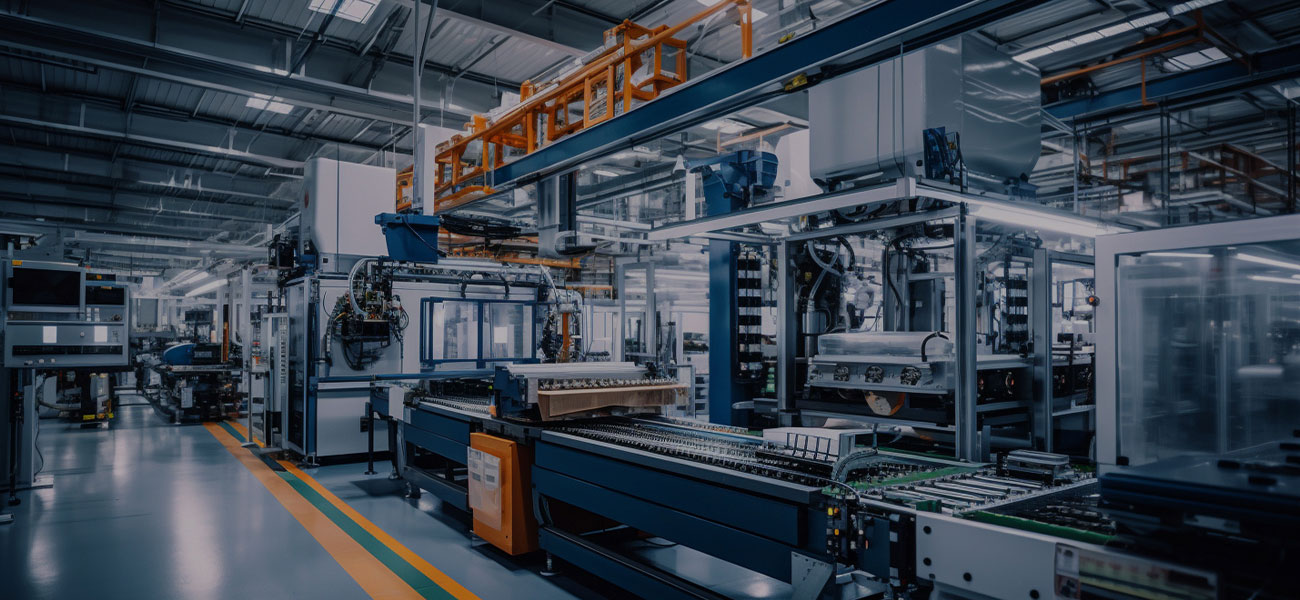
Batch is fed continuously into a tank furnace, where it melts into a homogeneous, bubble-free liquid. In practice, glass bottle manufacturing runs the furnace nonstop for years, because heating a tank from cold takes days and stopping it damages the refractory lining. That single fact explains a lot about supplier behaviour: your order is scheduled into a furnace campaign, not produced on demand.
From the furnace, the refined glass flows to the forehearth and is sheared by a sectioning machine into gobs — individually weighed parcels of molten glass. Gob weight is the first real quality control point in the glass bottle manufacturing cycle: a heavy gob wastes material, a light gob creates thin walls. Automatic gob-weight monitoring typically keeps variation to within a few grams so that every cavity on the line produces the same bottle.
Step 2: Forming — Blow-and-Blow, Press-and-Blow and NNPB
Forming is where glass bottle manufacturing creates the shape. Molten gobs drop into a blank mold for a first shaping step, and the method used here determines wall distribution, weight and which bottle shapes are even possible.
| Forming method | Best suited to | Wall control |
|---|---|---|
| Blow-and-blow | Narrow-neck bottles | Moderate |
| Press-and-blow | Wide-mouth jars and cups | Good, plunger-controlled |
| NNPB (narrow neck press and blow) | Lightweight narrow-neck bottles | Best, most uniform |
In blow-and-blow, compressed air forms a parison in the blank mold before the glass is transferred to the blow mold and inflated to final size. Press-and-blow replaces that first air puff with a metal plunger, which is why it controls wall distribution far more precisely and suits wide-mouth jars. Narrow neck press and blow (NNPB) combines the plunger with a narrow neck, and it is the technology behind lightweighting: NNPB forming delivers weight savings in the 10–15% range compared with conventional blow-and-blow, cutting both material and freight cost without changing the bottle’s outside dimensions.
This is also the stage where decoration constraints appear. A heavily embossed or faceted surface stresses the mold and slows the cycle, which is why custom glass bottle development always balances design ambition against formability — and why glass bottle manufacturing tolerances are agreed before the mold is cut, not after. For the forming steps in more technical detail, the Compax Packaging glass knowledge base is a useful industry reference.
Step 3: The Glass Bottle Annealing Process
A bottle that leaves the mold is unusable. Contact with a cold mold chills the outer surface while the core stays hot, locking in thermal stress that will crack the bottle during filling, transport or even storage — the failure the industry calls a cold explosion.
The glass bottle annealing process removes that stress, and it is the most under-specified stage in glass bottle manufacturing. Bottles travel through an annealing lehr on a conveyor: the lehr holds them at the glass annealing point of roughly 550–580 °C, then drops the temperature along a controlled curve until the glass reaches room temperature. The full pass takes about 30–90 minutes depending on wall thickness, and the slow, even cooling is what converts a fragile shell into a container that survives normal handling. Annealing is not optional and cannot be shortened for speed — if a supplier offers you an unusually fast cycle, ask how the lehr curve is validated.
Annealing is also the line between forming and finishing. Frosting, coating and printing are all applied to annealed labels, never to raw glass: frosted glass finishes and other surface treatments depend on a stress-free, dimensionally stable body.
Step 4: Coating, 100% Inspection and Packing
Two coatings are applied to protect the surface. The hot-end coating is applied at around 500 °C, before the lehr, using tin-based compounds that bond a tin oxide film to the glass; this fills micro-cracks and raises scratch resistance. The cold-end coating is applied below 100 °C after annealing, using a polyethylene or stearic-acid emulsion that lubricates the surface so bottles slide rather than scrape against each other on high-speed filling lines. Together they are the difference between a bottle that survives your line and one that arrives scuffed.
Inspection then decides what ships, and it is the final checkpoint in glass bottle manufacturing. Modern lines inspect 100% of output automatically rather than sampling it:
- Dimensions and verticality — height, body diameter, neck finish, straight standing
- Wall thickness uniformity — ultrasonic or optical measurement to prevent filling-line breakage
- Defect detection — bubbles, stones, cracks and inclusions are rejected
- Mouth flatness — the sealing surface that determines whether your pump, dropper or cap holds
- Pressure resistance — burst testing for internal pressure
Rejected bottles are chipped and returned to the furnace as cullet, which is one reason glass recycling loops are so tight.

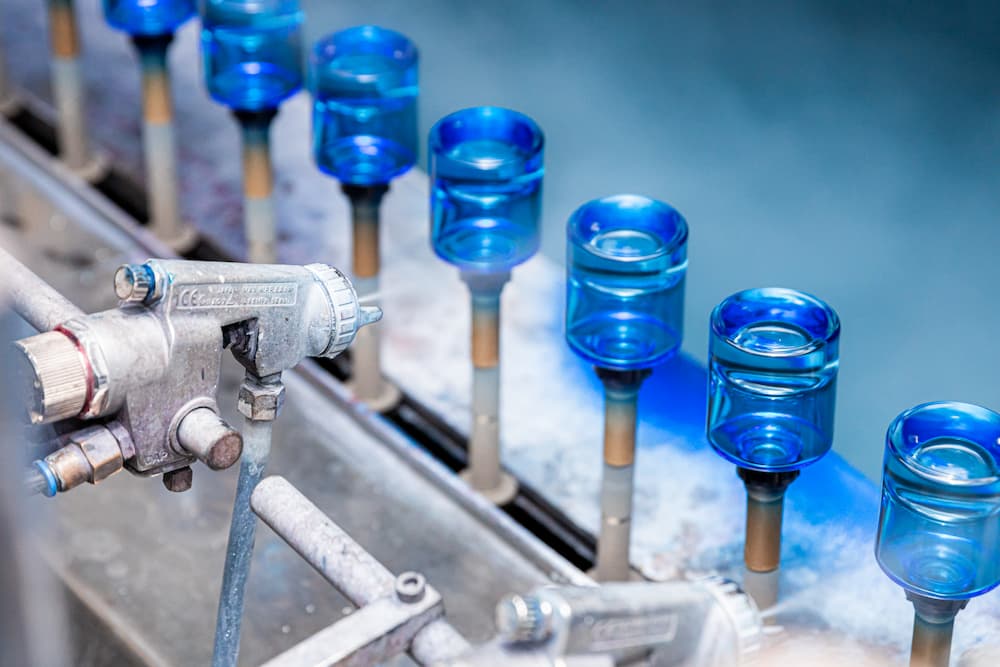
Only after inspection does decoration happen — color spraying, hot stamping or screen printing — followed by packing into layered pallets with interleaved board and shrink film.
What the Glass Bottle Manufacturing Process Means for Your Order
Once you know the stages of glass bottle manufacturing, the commercial questions answer themselves.
- Mold lead time. A custom glass bottle mold set has roughly seven components and typically takes 15–20 days to produce before glass bottle production begins. Add that to sampling and production when you plan a launch date.
- MOQ is a furnace economics question. A furnace campaign must be filled to be economical, so MOQ scales with bottle size and color — an unusual color or a heavy bottle raises the practical minimum.
- Sample bottles must come from the production mold. A hand sample proves the shape looks right; only a production-mold sample proves wall thickness, neck finish and capacity. Test the finished, decorated sample on your actual filling line before committing.
- Decoration is a second production run. Frosting, spraying, hot stamping and printing happen after forming, so they add their own lead time and reject rate — budget for it.
- Verify the bottle your product needs. A custom perfume bottle and an essential oil bottle can share a wall thickness and still fail on neck finish and UV protection.
Glass Packaging Market Outlook: Why Glass Keeps Winning
Glass bottle manufacturing demand is stable and growing rather than seasonal. According to Mordor Intelligence, the global glass packaging market moves from 132.06 million tons in 2026 to 154.86 million tons by 2031, a 3.24% CAGR, with bottles and jars already holding a 64.55% revenue share and flint glass taking 45.05%. Green glass is the fastest-growing color at a 5.26% CAGR, and Europe alone accounted for 37.75% of 2025 volume.
China, the largest supply base, is premiumizing. Mordor Intelligence puts the China container glass market at 11.51 million tonnes in 2026, reaching 13.29 million tonnes by 2031 at a 2.91% CAGR. Cosmetics and personal care is the fastest-growing end-user segment at a 3.49% CAGR, and glass bottles for beauty command an average unit price of USD 0.24 against USD 0.05 for beverages — roughly five times the value density of a drinks bottle.
Two supply-side shifts in glass bottle manufacturing matter for buyers. First, lightweighting: NNPB forming and process optimization are pushing average bottle weight down, which directly reduces your freight cost. Second, recycled content: urban recycling programs have lifted cullet to about 45% of furnace input in leading Chinese production hubs, improving both cost structure and the sustainability story you can tell on pack.
How Lianxin Controls Every Step of Glass Bottle Manufacturing
Because every stage above is verifiable, supply partners should be willing to show it. Lianxin supports custom glass bottle development from a 2D drawing through mold making, production-mold sampling, decoration and export packing, with inspection records available for your SKU. If you are comparing suppliers, ask for their furnace schedule, lehr parameters, wall-thickness tolerance and decoration reject rate — the answers tell you more than any catalogue.
Send us your bottle drawing, target volume and decoration requirement, and our engineering team will come back with a feasible specification, tooling lead time and price break.