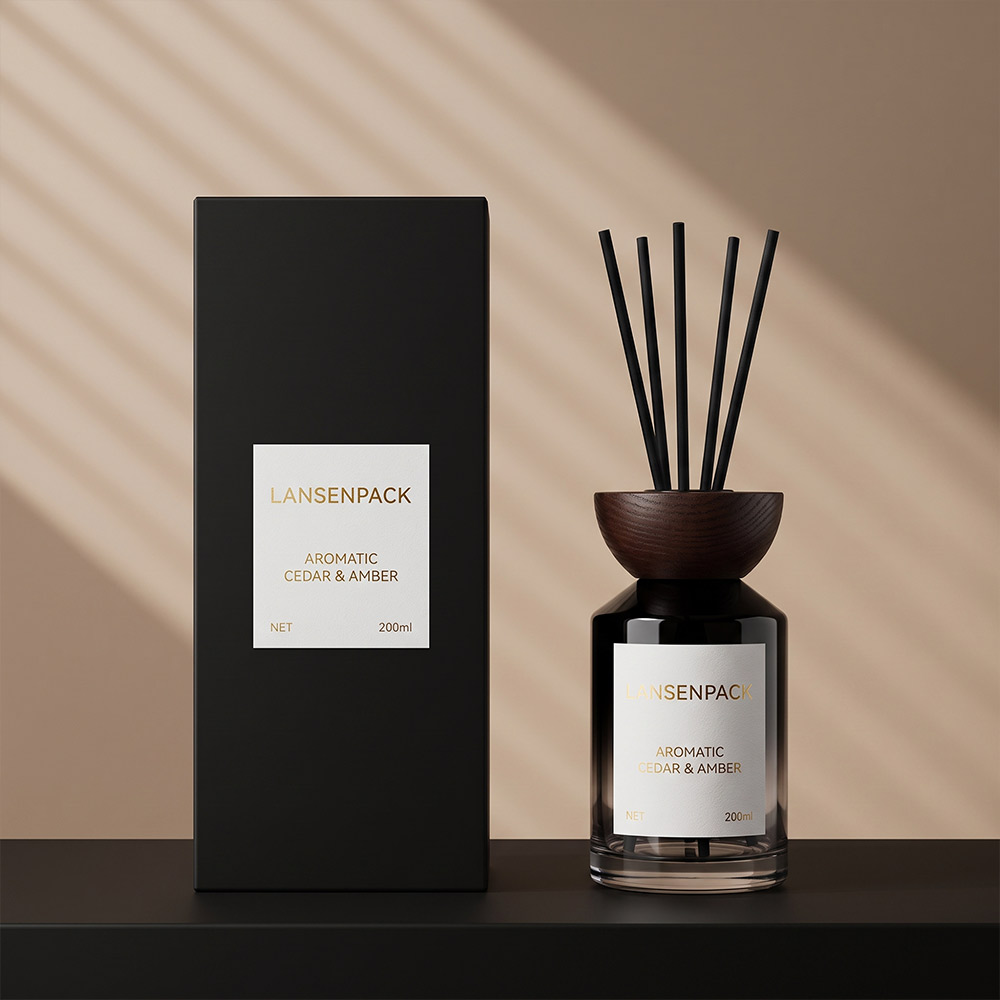
Reed diffuser bottles wholesale is one of the fastest-growing segments in fragrance packaging: the global home fragrance market is projected to grow from USD 27.28 billion in 2026 to USD 47.97 billion by 2034, and reed diffusers are the format many buyers are launching first. If you are sourcing reed diffuser bottles wholesale for your brand, the short answer is this: start with 100ml bottles for entry-level retail lines and 200ml bottles for premium home fragrance sets, in amber, clear or black glass, fitted with a no-leakage wooden or aluminum cap. Below, we break down standard sizes, glass finishes, caps, decoration options, MOQ expectations and the supplier checks that protect your first order.
- Best-selling sizes: 100ml (retail standard) and 200ml (premium, large-room favorite)
- Most popular glass: amber, clear, black and frosted finishes
- Closure: wooden or aluminum caps with leak-proof inserts
- Custom MOQ: always request the supplier’s stock-bottle vs. custom-mold MOQ table before sampling
Why Brands Are Sourcing Reed Diffuser Bottles Wholesale
Reed diffusers have moved from a niche aromatherapy accessory to a core category for candle brands, skincare houses and homeware retailers. Unlike candles, they need no flame, and unlike sprays, they release scent continuously for weeks — which makes the bottle itself a long-term brand touchpoint that sits visibly in living rooms and bedrooms.
HOME FRAGRANCE MARKET (FORTUNE BUSINESS INSIGHTS)
$27.28B (2026) → $47.97B (2034)
Projected CAGR of 7.31%
REED DIFFUSER MARKET (MARKET.US)
$839M (2024) → ~$1.53B (2034)
Projected CAGR of 6.2%
Both projections explain why more private-label brands are entering the category now rather than later: the window for shelf space is still open, and the supply chain — glass bottles, caps, reeds, fragrance oil and gift boxes — is mature enough for small-batch entry. According to Fortune Business Insights, the home fragrance market will grow at a 7.31% CAGR between 2026 and 2034, while Market.us estimates the reed diffuser segment alone will roughly double over the same window. For glass bottle suppliers, that demand shows up as rising orders for stock 100ml and 200ml diffuser bottles with short customization cycles — the same production pattern our perfume bottle manufacturing lines serve every month.
Standard Reed Diffuser Bottle Sizes: Which One Should You Choose?
Most reed diffuser bottles sold wholesale fall into a predictable size ladder, and choosing correctly depends on your retail price point, oil volume and room-size claim. Supplier guides consistently list 50ml to 250ml as the working range, with 100ml described as the “gold standard” for consumer reed diffusers and 200ml recommended for larger rooms and open-plan spaces.
| Bottle size | Best suited for | Typical retail positioning |
|---|---|---|
| 50ml | Travel, trial, gift-with-purchase | Entry price point |
| 100ml | Standard bedroom / bathroom diffusion | Best-selling core size |
| 150ml | Mid-range lines, longer lasting | Value upsell |
| 200ml | Living rooms, open-plan areas, premium sets | Flagship / gifting format |
| 250ml+ | Hotels, spas, large commercial spaces | Contract / B2B orders |
For a first launch, most brands run two SKUs: a 100ml “starter” size and a 200ml “hero” size, often bundled in a gift box. The 200ml format matters commercially because reed diffusers are frequently bought as presents — the bottle needs enough visual mass to justify the price, which is why luxury versions pair the bottle with a rigid box and branded cap. If you plan to offer both, check that the supplier’s neck finishes and cap sizes are consistent across your size range so your reeds and closures can be shared, simplifying inventory.
Glass Colors and Finishes: Amber, Clear, Black and Frosted
Glass color is a functional decision, not just a style one. Amber glass blocks UV light, protecting fragrance oils from degradation and shelf-life complaints — the reason it dominates natural and aromatherapy lines. Clear glass shows the oil color and level, which suits brands that sell the liquid’s visual appeal. Black glass reads instantly as luxury and hides oil sediment, while frosted surfaces soften the look, hide fingerprints and give a matte, premium touch.
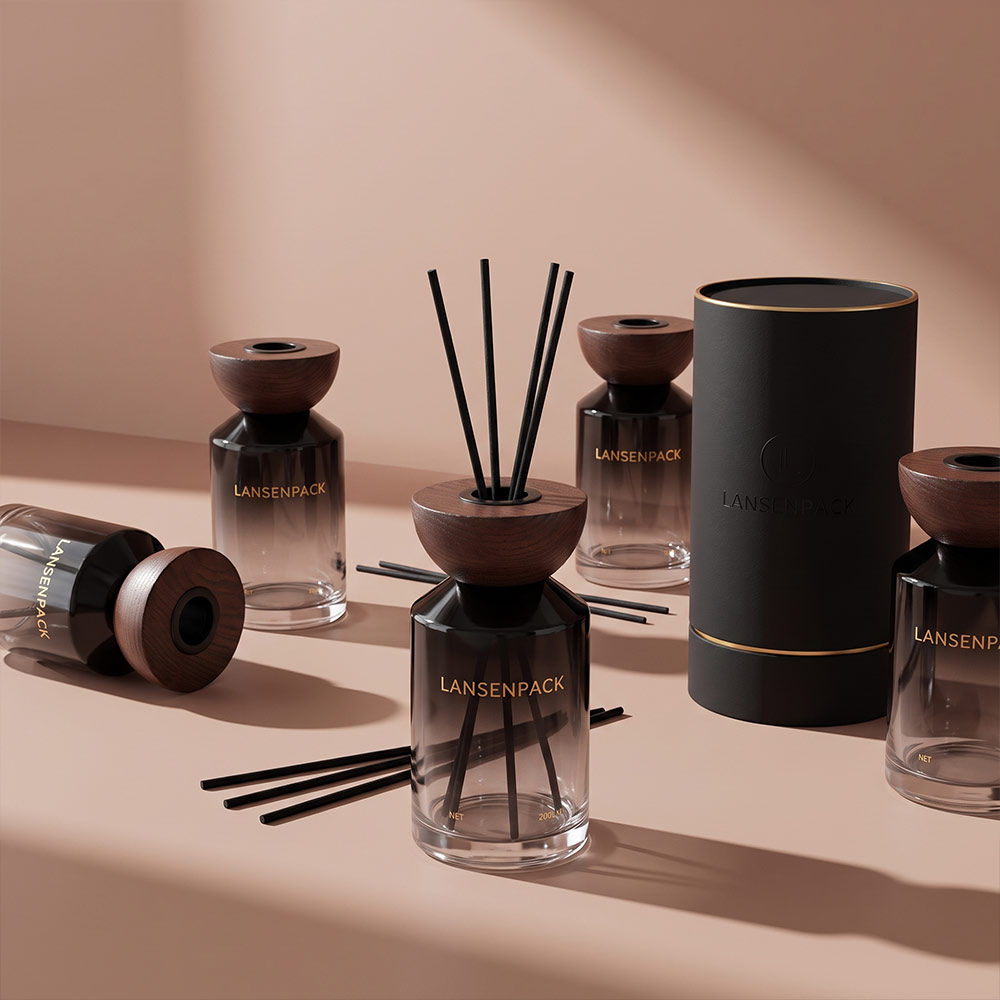
Finish is the layer where brands differentiate at low cost. Frosted glass bottles can be produced by acid etching or sandblasting and pair beautifully with a debossed or printed logo, while custom color glass lets you match a house Pantone shade for the body itself. Some brands combine techniques — a clear bottle with a frosted band, or black glass with a sprayed interior — to create a SKU that does not exist on the competitor’s shelf. Ask your supplier which finishes they run in-house, because combining frosted, color spraying and labeling in one factory shortens lead time and reduces quality disputes.
Caps, Reeds and Closures: Details That Prevent Leaks and Complaints
The cap is the highest-risk component of a reed diffuser. Diffuser oil is thin and creeps along threads, so a decorative cap with a poor seal produces the two most common customer complaints: leakage in transit and evaporation loss on the shelf. For wholesale orders, specify a cap with an inner insert or gasket rather than judging by looks alone.
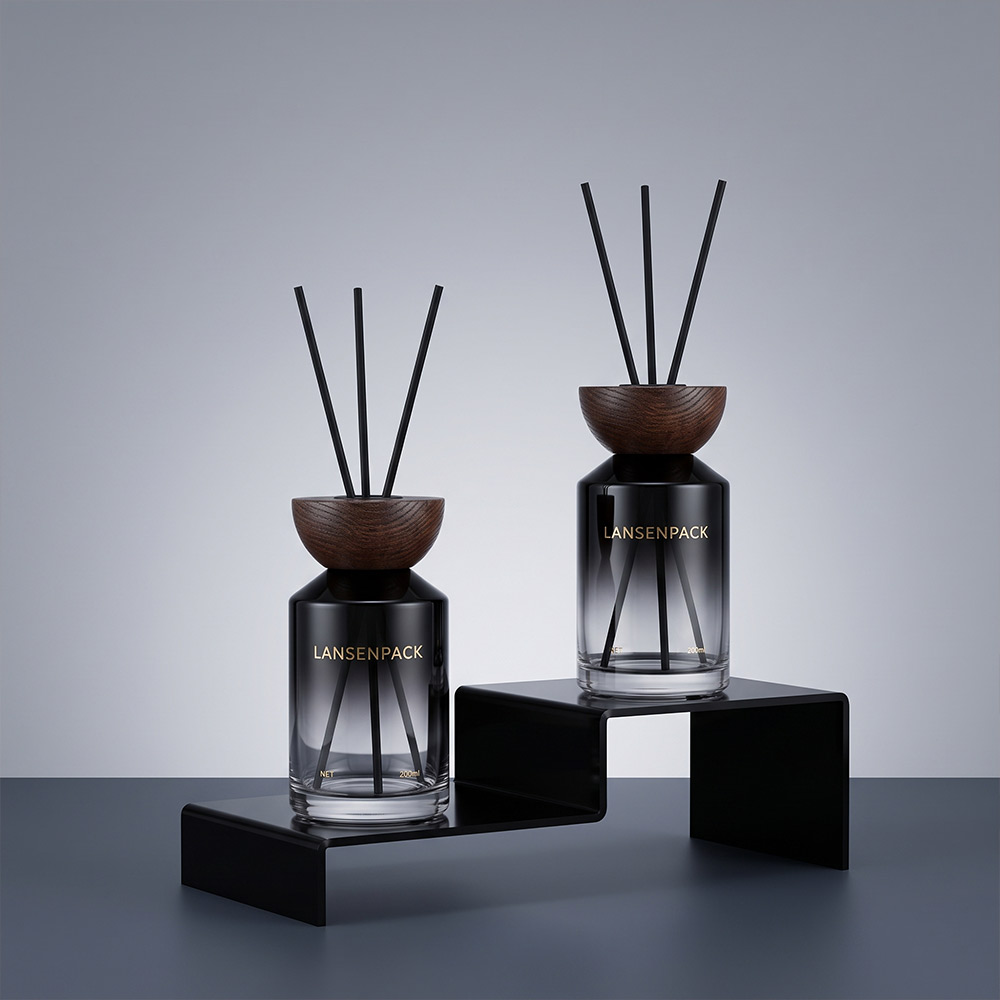
Material choice shapes the brand story. Wooden caps (bamboo, birch, oak) suit natural and sustainable lines; aluminum caps in brushed, anodized or painted finishes suit modern and luxury positioning; plastic caps remain the economical option for value ranges. Whichever you choose, verify the cap matches the bottle’s neck size and that the supplier has tested the filled unit — bottle, cap and oil together — for leak resistance and reed wicking. Reeds themselves should be part of the quotation: rattan reeds are the standard choice, and the number of reeds your customer inserts controls scent intensity, so include usage instructions on the label or insert card.
MOQ, Decoration and Lead Time for Custom Reed Diffuser Bottles
Stock bottles with minor customization are the fastest route to market: choosing an existing mold, a standard neck and a stock cap removes tooling cost and cuts lead time significantly. Fully custom shapes require mold investment and higher quantities, so most first-time buyers validate the market with a stock bottle decorated to their brand before committing to a proprietary mold.
- Start with stock shapes — same mold, your decoration — to test demand with the lowest MOQ and shortest lead time.
- Decorate before you commit to glass color changes — logo work such as hot stamping or silk-screen printing is low-cost and can be layered over clear, amber or black glass.
- Prototype new shapes before mold investment — suppliers can produce 3D printed glass bottle prototypes so you can check proportions, cap fit and label area before paying for a production mold.
- Ask for the supplier’s MOQ table — stock bottles, decorated stock bottles and custom-mold bottles each carry a different minimum, so request all three figures plus sample cost and lead time in writing.
- Confirm compliance documents — for export to the EU and US, request material compliance statements (such as REACH and Prop 65) and heavy-metal test reports for decorated glass before mass production.
Full-service suppliers combine all of these steps under one roof. If your design involves several techniques — a custom bottle body, a sprayed or frosted finish, a hot-stamped logo and a gift box — review our glass bottle customization options to see which combination fits your budget and timeline.
Summary: Build Your Reed Diffuser Line Step by Step
A profitable reed diffuser launch comes down to four decisions made early: pick the 100ml and 200ml sizes as your core range, choose amber or black glass for premium positioning, invest in a genuinely leak-proof cap, and start with a decorated stock bottle before commissioning a custom mold. The category is growing at a double-digit pace and the packaging supply chain is ready for brands of every size — the bottleneck is usually just a clear specification.
Get a Free Quote for Reed Diffuser Bottles
Send us your target sizes, glass color and cap preference — we’ll reply with MOQ, pricing and lead time.